The last description in this series is Collaborator or Co-creator. These two descriptions capture mission as a joint work together between missionary and locals, as equals, where both parties play a role. Although technically not a picture, the overall sense of both of these is in the combining of two parties in partnership towards one goal. And while I’m not technically a linguist, it seems to me that the term collaborator gives the sense of labouring together.
A further aspect of these descriptions is the feature of both parties bringing expertise to the table in order to make something new. In this way, both parties are essential and neither is enough on their own. This resonates when I think about teaching theology; I’m trying to bring theological ideas through English to Khmer. My theological ideas are not enough on their own and neither is Khmer enough on its own. But in the combination, there is a synergy in the process of coming together. Co-creator builds on this coming-together aspect but also points to the creative aspects of partnerships, a creativity that mirrors the Creator. Something new is created as we wrestle with theology from English to Khmer.
I’m currently trying to write an article on missiology about the role of resources in mission. One of the things I’m toying with is the idea of a missionary as a resource. Money is clearly a resource, language too is a resource. Surely the missionary is a resource too. In this framework, I ask what the role of external resources is in relation to internal (local) resources.
This picture of a missionary as a resource echoes the coach picture, here, in terms of being a resourcer. However, characterising the missionary as a resource provides some passivity to the missionary role. That is, the resource is at the service of the local. They can use the resource in the way they think. Instead of it just being about what the missionary thinks is important, they allow themselves to be directed and used like a resource would be. They hand over power to someone else. This picture seems to empower the local while at the same time disempowering the missionary in a vulnerable way. Agency is located more with the local than the missionary.
Even though missionaries may know a thing or two, their expertise in this metaphor are placed subordinately to the locals and directed towards goals that the missionaries themselves may not have thought of or thought important prior to being involved in mission. As a resource the missionary is put in the service of another rather than servicing their own goals.
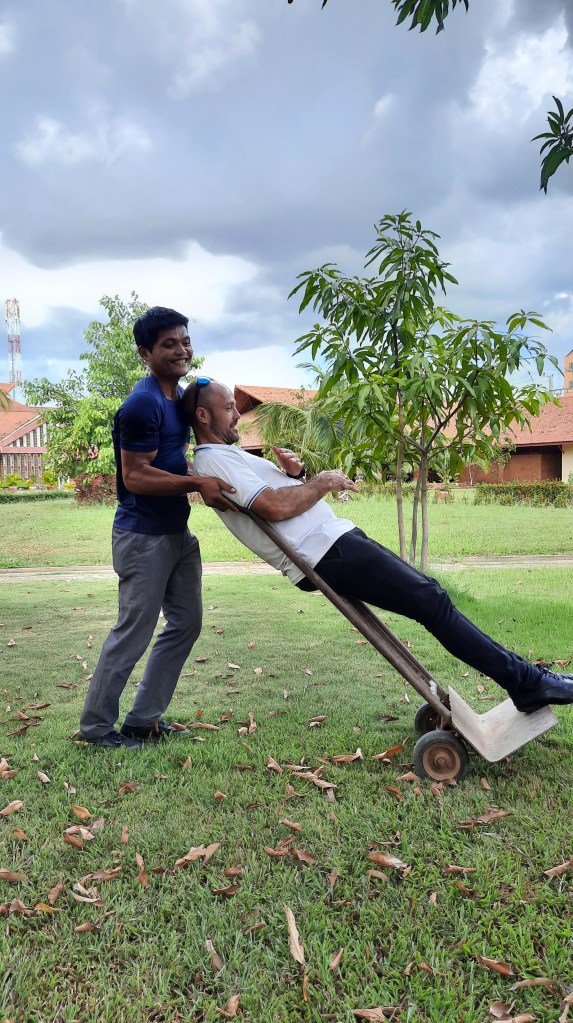
I like the picture, because my arms display my unreadiness. When you are the resource, change comes not from a position of control, but from outside and we are less ready for it than when as the agent we try to make the change happen ourselves.
This is my earliest recorded language mistake, after a month on location, now immortalised. I was trying to say ‘I like to ride a bike’. I ended up saying the equivalent of ‘they like wide-ing bic-eze’.
One movie my family loves is The Terminal.Tom Hanks plays a guy stranded in an airport without any English. As he learns English he is able to interact with a love interest (Katherine Zeta-Jones). In a hilarious moment, his hours of practicing asking her out with the phrase, ‘Would you like a bite to eat?’, comes out ‘Eat to bite’. Learning a second language is hard. But our own languages are hard too. And Khmer is hard for Cambodians too.
I was trying to use a Khmer word in class. I had written it up on the board so that it wasn’t just my pronunciation that they were stumbling over. My Khmer students didn’t understand. The word had been translated by another lecturer, so I wasn’t 100% sure why this word had been used. I knew another word that conveyed the meaning of my English word, so I used that instead.
There were a few things happening in this situation. The first is that this shows where I am starting to get up to in my Khmer language (following on from my recent language update). As I teach, we are wrestling together (the students and myself and other lecturers) about the best Khmer words to use. There is a normal and not-normal aspect to this situation. Because Khmer is their language not mine, my immediate reaction is to question whether I’ve got it right. This is a good reaction, but not a normal reaction. If I was working in English, I wouldn’t have that same questioning (though maybe I should). So the first thing that happens is I question whether the word I’ve used is right or not.
Second, this situation illustrates an important part of the Christian journey for every Christian regardless of language. In English and Khmer, growing in our faith means growing in our Christian vocabulary, understanding new words that help us learn about God and ourselves. So becoming and growing as a Christian has a learning-a-new-language component to it too. Just like if we were a doctor we would need to learn all the technical terms for sickness and such. In my head I wonder whether this situation is one of these moments, a chance for the students to learn some new vocab for their faith.
Third, this situation also illustrates an aspect of the Khmer language. There are two language modes, royal language and street language. Royal language are terms that you would use in relation to the king or divinity or a monk, but you wouldn’t use them in relation to an average person. They tend to be more academic and used seldomly in regular life. The second mode is general language used more in common conversation and even academic situations outside of those specific examples above. The particular wrestle is when to use royal language for Jesus and when not to. It can help to highlight his divinity. But it can also distance his humanity from ours when different words are used to describe him and for us. This is an interesting discussion that I have with my students. At present I just go for the both/and approach. Both terms have their importance. So sometimes when my students don’t understand it’s because the language is tricky and unfamiliar, even for them.
My favourite Intro to the Bible overview that I was taught by Dr Bill Salier.
I recently made a trip to a provincial town, Battambang. I think it’s the second or third largest city in Cambodia. There, representing PPBS, I was teaching Education by Extension (EE), a way to bring theological education to places in Cambodia that have less resources and opportunities to receive training in theology.
My teaching program content was very similar to a one hour lesson that I did four years ago to residents from a province not far from Battambang, Koh Kong as they visited with a good friend of mine, Dr Jeff Hogue. See here for that post. The differences are shocking! That first time I taught for one hour. This time I taught for 18 hours in 3 days. That time I spoke in Khmer maybe 20-40% of the time. This time basically 100% Khmer. Then I had a missionary friend use the main concepts that I was trying to communicate and use his Khmer to get the points across. This time I had a Khmer lecturer give me tips (like that I should not say that the Israelites wanted to have sex with a king). Last time I had little interaction with individual students. This time we laughed when I said map instead of promised land, or when I couldn’t get my mouth around a fairly standard word. That time I couldn’t explain beyond the basics. This time I could talk about the nature of covenants, use the word for ‘important themes’ to show literary devices particularly in the Old Testament and convey the abstract ideas like the benefit of understanding context using the illustration of sight and touch as two ways to learn things.
I found out just recently that one of the things my missionary friend back then was impressed by was how little Khmer I had and yet I was giving it a go. Now I see the fruit of years of language learning. For those who are currently language learning (of which I still am), keep at it. It gets easier. And it’s so encouraging looking back.
In my teaching at the Bible School, while there have been some good Khmer theology resources produced, one remains my favourite. J.I Packer’s ‘Concise Theology’ has been translated by the current Principal of Phnom Penh Bible School (PPBS). It remains my favourite text as I teach my theology subjects. At present I would call it the gold standard for Khmer theology. It has helped me learn Khmer more, particularly theological Khmer, and provides a great resource that my students and I read and discuss together in my theology classes.
For those who are podcast listeners and want an indepth history of Cambodia to listen to, particularly in relation to the Khmer Rouge, then I can’t recommend enough Lachlan Peter’s podcast, Shadows of Utopia. This podcast is worth the listen.
In January it was six years since we first arrived in Cambodia. I’m about to start my seventh semester of teaching at the Bible school (PPBS). It’s the first year I’ll be able to teach the same subjects a second time and I’m looking forward to tweaking content rather than weekly content creation for the first time. Its also the first time I’m teaching without a translator in class. Look at me with my big boy pants on.
I remember speaking to a missionary at Summer School (CMS’s annual conference) and he was talking about the missionary timeline. He said something like this. First term just aim to survive. Don’t die. Stay married. Second term aim to make a list of all the things you might want to do. Third term address the first point on that list. What was useful about this observation was keeping my expectations realistic about the slowness and patience required in mission work. This has been a helpful frame that has proved true from experience so far.
There has also been a change in how I serve here in Cambodia. In the beginning it was very individually based. Though going to a language school, language learning is essentially something that you do yourself. You set your goals and work towards them. When I started teaching it was a similar phenomenon. I would set the syllabus and the content would come from there. Over the last year or so, as my proficiency in Khmer and teaching in Khmer has improved, I’ve taken on more responsibility at the school in a different way. Being involved in a more administrative capacity has meant that that essentially individual feature of the last five years has morphed to a more team or group approach at work. In essence working more as a team is just a different mode from primarily on your own at your own pace. This has been a change that has really only occurred in this second term.
It’ll be interesting to see what change(s) occur as we finish out this second term and look to our third.
This post follows on from the previous post about where I’m up to in my language learning with a wider reflection on the things that assist us as we learn a new language.
One of the things that has struck me as I continue to develop my Khmer language skills is the number of supports it takes to learn a language. It takes a whole village, or a village of institutions, for me to be where I am now in Khmer language ability.
Firstly, a vital institution for language learning is the CMS fellowship, with both its priority on long term mission and the importance it places in learning the local language in order to be able to stay long term. Added to this is all those churches and individuals who support us through CMS to enable us to devote good time to language learning.
Secondly, there is the language school that I attended, G2K (Gateway to Khmer). This second institution gave me the foundation I needed to begin learning Khmer and continue learning Khmer in years to come. This school provided me with all the basics for speaking, listening, reading and writing Khmer as well as setting me up to continue learning Khmer once I had finished their program. It is the most well rounded language learning institution in Cambodia at present. It’s classroom model is invaluable.
The third institution that has helped me develop my Khmer has been the Bible School where I teach, Phnom Penh Bible School (PPBS). The opportunity to begin teaching in Khmer with the help of a translator has meant that all those skills that I picked up when I was full time language learning I was able to continue to hone as I taught. Beginning with teaching the Old Testament I was able to pick up a whole lot of new Christian Khmer vocabulary that would serve as a wonderful foundation for now as I teach theology. The school relationships that I have built have also provided a rich help in my Khmer both with time to practice and assistance with learning new words and concepts in Khmer.
Finally, most importantly, the institution of my family has provided me with the stability to live in Cambodia and learn Khmer in different ways. It is these relationships (including my extended family and how they formed me as a person and language learner) that continue to play a part in my language development.
God has been at work through this village of institutions to help me to learn and grow in my ability to communicate in Khmer.
See the books near my drink bottle? They are the Khmer and English versions of key textbooks
Since my last language update, a lot has changed, a lot of time under the bridge. I get the question now, more than I used to: Are you fluent? My answer: Enough. Maybe you could call it functional fluency. When I speak to new Khmer people and they comment on my Khmer, my answer is usually ‘some days enough, some days not enough’. I can enter a conversation with a Khmer person now and most days I can understand what they are trying to communicate with varying degrees of clarity concerning details. I don’t feel nervous talking in Khmer anymore. Five years of language investment and I’m reaching the stage where I am generally comfortable communicating in Khmer. Do I still get lost when two Khmer people are speaking to each other? Absolutely. Are there times when I need to use English because I don’t understand? Yup. But these times are becoming less and less.
In the classroom my need for a translator is diminishing. Since January I’ve started to teach without a translator present. I say to people that the quality of my content that I can deliver would go from an 80% with a translator to a 70% without one. I would be missing some insights and descriptive clarity, but I can get the most important points across now.
One thing I have noticed. When I began teaching I couldn’t really read technical Khmer language so I used to write my own notes in Khmer and get them checked and then use that. Since returning I have moved to a situation where I write my notes in English then get a translator to translate it into Khmer for me. My reading ability means that I can use their translation in a way that I couldn’t in the beginning. As a result my reading of Khmer has improved while my typing of Khmer has slowed and become more tricky.
The way I look at my learning of Khmer up till now is that my language learning has been an investment that I now get to reap the rewards. I can go deeper relationally. I can go deeper in my ability to communicate and I don’t get a headache from using Khmer too much like I used to. I still get tired after using Khmer. I still get lost when using Khmer. But I’m content with my ability while all the while still seeking to improve. Improvement at present is particularly around listening to Khmer sermons to flood myself with input language times where I’m just getting more and more used to local phrases and ways of expressing things.
It’s been a while. Apart from our latest post, the post before that was one we did from Australia in 2020, before we knew our flights would be canceled, again. So what has been happening since then? This next series catches you up, not only on some of the details of our goings-on, but also adds in new cultural and missiological insights that we’ve picked up along the way. For those who receive our monthly updates, the beginning of this series will be a helpful reminder of our journey in recent years giving good context to where we are up to as well as going into details that we can’t always fit in our monthly updates. Hope you enjoy the ride.
My translator. I have much Khmer to learn from him as he does English from me.
There is a truth to the title that I didn’t realise before I moved to Cambodia. Pre-arriving in Cambodia I was all about learning the local language and helping locals to engage with theology in their own ‘heart’ language. Then any speaking I did with them would be helping both of us as I was learning the language and they were engaging in theology in a language that they are proficient in. So I would try in as many contexts to speak in Khmer, rather than in English. And, to a certain degree, I haven’t changed this view. Learning Khmer is extremely helpful for me and others. What has happened is that, instead of changing this view about learning language, I’ve enriched it, or added to it, even nuanced it.
My view now is all of the above AND for a few people I’m going to speak English with them. For these few people it is actually selfish for me to learn their language. They should be the ones learning language. They need to improve their English.
The reason English is important, and I didn’t see this before, is that for Christians in Cambodia at the moment to progress in theological education they need to do that further study in English. Not only do they need sufficient English to progress, but they need theological English (which might as well be another language). The reason is simple. There are not enough theological resources in Khmer to sustain a Masters level degree or higher. The point could be argued for Bachelor degrees as well, but that’s a whole kettle of fish that I don’t know if I want to get into right now (though I would love to engage this point).
Given the need for English skills to progress in theological education, rather than just seeking to speak Khmer with my fellow Khmer colleagues at the Bible School, I should be using some of my time to help them improve their English. Now this is not an easy swap, English for Khmer, because they have an important role in developing my theological Khmer. However, there is a mutual need that I didn’t see before. They need theological English from a native English speaker and I need theological Khmer from a native Khmer speaker. To just work in Khmer with them all the time would be selfish. There is a mutuality in learning language that I knew in principle from missiology, but needed to expand my approach to others learning Khmer.
This needs further qualifying. While I want to speak with them in English, my thought is that this is best done one to one. In group settings at the Bible school I think speaking in Khmer gives them the power and ability to interact in a language that they are comfortable with rather than in a second language which is harder. So in group settings I prefer Khmer. In one on one relationships with a few, English.





 corksincambodia.com