The last description in this series is Collaborator or Co-creator. These two descriptions capture mission as a joint work together between missionary and locals, as equals, where both parties play a role. Although technically not a picture, the overall sense of both of these is in the combining of two parties in partnership towards one goal. And while I’m not technically a linguist, it seems to me that the term collaborator gives the sense of labouring together.
A further aspect of these descriptions is the feature of both parties bringing expertise to the table in order to make something new. In this way, both parties are essential and neither is enough on their own. This resonates when I think about teaching theology; I’m trying to bring theological ideas through English to Khmer. My theological ideas are not enough on their own and neither is Khmer enough on its own. But in the combination, there is a synergy in the process of coming together. Co-creator builds on this coming-together aspect but also points to the creative aspects of partnerships, a creativity that mirrors the Creator. Something new is created as we wrestle with theology from English to Khmer.
I’m currently trying to write an article on missiology about the role of resources in mission. One of the things I’m toying with is the idea of a missionary as a resource. Money is clearly a resource, language too is a resource. Surely the missionary is a resource too. In this framework, I ask what the role of external resources is in relation to internal (local) resources.
This picture of a missionary as a resource echoes the coach picture, here, in terms of being a resourcer. However, characterising the missionary as a resource provides some passivity to the missionary role. That is, the resource is at the service of the local. They can use the resource in the way they think. Instead of it just being about what the missionary thinks is important, they allow themselves to be directed and used like a resource would be. They hand over power to someone else. This picture seems to empower the local while at the same time disempowering the missionary in a vulnerable way. Agency is located more with the local than the missionary.
Even though missionaries may know a thing or two, their expertise in this metaphor are placed subordinately to the locals and directed towards goals that the missionaries themselves may not have thought of or thought important prior to being involved in mission. As a resource the missionary is put in the service of another rather than servicing their own goals.
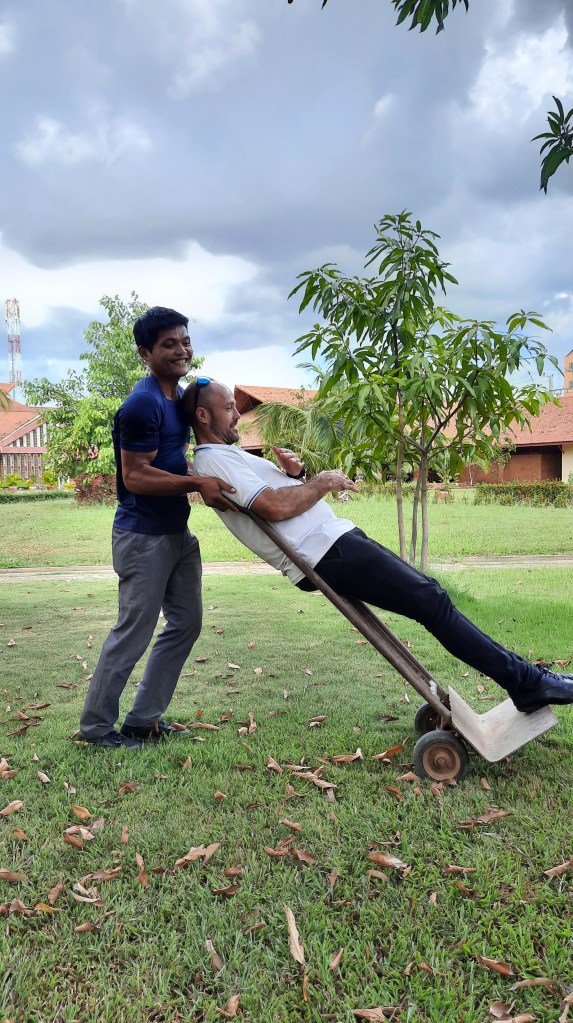
I like the picture, because my arms display my unreadiness. When you are the resource, change comes not from a position of control, but from outside and we are less ready for it than when as the agent we try to make the change happen ourselves.
This description, shared before, here, combines the sniper and coach in a different way. The goalie has special skills that the other players don’t. The missionary as goalie emphasizes that mission is done together as a body, as a team, not just as an advisor. They have an important role but they are generally not the ones kicking goals for the team. Their place is at the back, sort of behind the scenes in some sense. Yet being at the back they see things slightly differently from other players who are more in the midst. Good goalies will communicate what they see to the whole team. They provide helpful information, like a coach, yet as a player. Goalies have some special abilities that other players don’t. They can use their hands. However, their special abilities are limited to a small arena in comparison to the whole field. The goal square sets good limits on the goalie’s abilities to be contained and used for the right purposes.
When I think about theology in relation to mission the role of the goalie resonates in this regard. Missionaries can provide a wealth of information particularly in relation to theology that comes from the world-wide church. Like the goalie they provide a point of view that assists the other players as they create and apply theology. Yet they are not the ones who see theology develop (score goals). That is done by other players, by the teamwork of the whole team, goalie included but not goalie exclusively. In preventing goals, maybe this is a good metaphor for preventing heresies or problems from occurring. Yet in reality this is a normal part of missionary work. We help and yet even in our helping we create problems, hopefully unintentionally.
The goal square for me feels like Phnom Penh Bible School (PPBS). In that square I can jump around and use my hands. Outside PPBS, I’m not only limited to my feet, but the goal remains unguarded. Thus expeditions out of the square should be well calculated and brief as I focus on my main role.
The picture of a sniper resonates with my experience of being a missionary particularly as it relates to timeline and target. On numerous recountings, I have described a former missionary’s perspective on mission to me, as we chatted at CMS Summer School one year. He said to me in the first term, learn the language and don’t kill anyone (other versions are stay married or make a friend). Second term, you can make a list of all that needs addressing. Third term, you can address the first item on that list only. Over roughly 10 years, this is a rough sketch of the missionary timeline and target.
To me the above timeline and target matches the picture of a sniper as one part of the way an army wins a war. Snipers have a key expertise. They can take out a small target from a long way away. In terms of mission service, aiming for taking out a target in the third term of service echoes this ability. It echoes the waiting and watching, basically just the time involved in this task; mission work is time intensive. Patience is required; is demanded.
The sniper pic also echoes needing a good vantage point; it takes time to learn a new culture and be able to start to speak into it. Even though I know Khmer culture more now than when I first came, I’m less inclined to offer strong pronouncements about what Khmer Christians should do; my vantage point has shown me all the things that I don’t know about Khmer culture. A wise missionary said it was easiest to teach a book of the Bible, harder to teach doctrine and even harder to teach practical ministry subjects cross-culturally. Each step requires more and more cultural knowledge to do well.
Finally, the sniper metaphor highlights a sniper’s weakness. If the enemy gets in close they are at a disadvantage in hand to hand. While a sniper is specialised, their speciality is a liability when it comes to other activities. A weakness of mine at the moment is that I struggle to understand conversations between Khmer speakers that don’t involve me. This weakness reminds us that a sniper is only one part of an army. They won’t win the war, but they play an important part. Their specialist equipment speaks to the skills they bring that are ultra good at one thing and not great at others.
As I think about timeline and target in our context: First term learn Khmer (though, never finish learning). Second term begin teaching in Khmer and later give leadership a go. Third term becomes a culmination of the first two terms: improving teaching in Khmer as I lead in various capacities. This hopefully gives you a sense of my sniper technique in terms of target and timeline.
My favourite Intro to the Bible overview that I was taught by Dr Bill Salier.
I recently made a trip to a provincial town, Battambang. I think it’s the second or third largest city in Cambodia. There, representing PPBS, I was teaching Education by Extension (EE), a way to bring theological education to places in Cambodia that have less resources and opportunities to receive training in theology.
My teaching program content was very similar to a one hour lesson that I did four years ago to residents from a province not far from Battambang, Koh Kong as they visited with a good friend of mine, Dr Jeff Hogue. See here for that post. The differences are shocking! That first time I taught for one hour. This time I taught for 18 hours in 3 days. That time I spoke in Khmer maybe 20-40% of the time. This time basically 100% Khmer. Then I had a missionary friend use the main concepts that I was trying to communicate and use his Khmer to get the points across. This time I had a Khmer lecturer give me tips (like that I should not say that the Israelites wanted to have sex with a king). Last time I had little interaction with individual students. This time we laughed when I said map instead of promised land, or when I couldn’t get my mouth around a fairly standard word. That time I couldn’t explain beyond the basics. This time I could talk about the nature of covenants, use the word for ‘important themes’ to show literary devices particularly in the Old Testament and convey the abstract ideas like the benefit of understanding context using the illustration of sight and touch as two ways to learn things.
I found out just recently that one of the things my missionary friend back then was impressed by was how little Khmer I had and yet I was giving it a go. Now I see the fruit of years of language learning. For those who are currently language learning (of which I still am), keep at it. It gets easier. And it’s so encouraging looking back.
In my teaching at the Bible School, while there have been some good Khmer theology resources produced, one remains my favourite. J.I Packer’s ‘Concise Theology’ has been translated by the current Principal of Phnom Penh Bible School (PPBS). It remains my favourite text as I teach my theology subjects. At present I would call it the gold standard for Khmer theology. It has helped me learn Khmer more, particularly theological Khmer, and provides a great resource that my students and I read and discuss together in my theology classes.
For those who are podcast listeners and want an indepth history of Cambodia to listen to, particularly in relation to the Khmer Rouge, then I can’t recommend enough Lachlan Peter’s podcast, Shadows of Utopia. This podcast is worth the listen.
In January it was six years since we first arrived in Cambodia. I’m about to start my seventh semester of teaching at the Bible school (PPBS). It’s the first year I’ll be able to teach the same subjects a second time and I’m looking forward to tweaking content rather than weekly content creation for the first time. Its also the first time I’m teaching without a translator in class. Look at me with my big boy pants on.
I remember speaking to a missionary at Summer School (CMS’s annual conference) and he was talking about the missionary timeline. He said something like this. First term just aim to survive. Don’t die. Stay married. Second term aim to make a list of all the things you might want to do. Third term address the first point on that list. What was useful about this observation was keeping my expectations realistic about the slowness and patience required in mission work. This has been a helpful frame that has proved true from experience so far.
There has also been a change in how I serve here in Cambodia. In the beginning it was very individually based. Though going to a language school, language learning is essentially something that you do yourself. You set your goals and work towards them. When I started teaching it was a similar phenomenon. I would set the syllabus and the content would come from there. Over the last year or so, as my proficiency in Khmer and teaching in Khmer has improved, I’ve taken on more responsibility at the school in a different way. Being involved in a more administrative capacity has meant that that essentially individual feature of the last five years has morphed to a more team or group approach at work. In essence working more as a team is just a different mode from primarily on your own at your own pace. This has been a change that has really only occurred in this second term.
It’ll be interesting to see what change(s) occur as we finish out this second term and look to our third.
This post follows on from the previous post about where I’m up to in my language learning with a wider reflection on the things that assist us as we learn a new language.
One of the things that has struck me as I continue to develop my Khmer language skills is the number of supports it takes to learn a language. It takes a whole village, or a village of institutions, for me to be where I am now in Khmer language ability.
Firstly, a vital institution for language learning is the CMS fellowship, with both its priority on long term mission and the importance it places in learning the local language in order to be able to stay long term. Added to this is all those churches and individuals who support us through CMS to enable us to devote good time to language learning.
Secondly, there is the language school that I attended, G2K (Gateway to Khmer). This second institution gave me the foundation I needed to begin learning Khmer and continue learning Khmer in years to come. This school provided me with all the basics for speaking, listening, reading and writing Khmer as well as setting me up to continue learning Khmer once I had finished their program. It is the most well rounded language learning institution in Cambodia at present. It’s classroom model is invaluable.
The third institution that has helped me develop my Khmer has been the Bible School where I teach, Phnom Penh Bible School (PPBS). The opportunity to begin teaching in Khmer with the help of a translator has meant that all those skills that I picked up when I was full time language learning I was able to continue to hone as I taught. Beginning with teaching the Old Testament I was able to pick up a whole lot of new Christian Khmer vocabulary that would serve as a wonderful foundation for now as I teach theology. The school relationships that I have built have also provided a rich help in my Khmer both with time to practice and assistance with learning new words and concepts in Khmer.
Finally, most importantly, the institution of my family has provided me with the stability to live in Cambodia and learn Khmer in different ways. It is these relationships (including my extended family and how they formed me as a person and language learner) that continue to play a part in my language development.
God has been at work through this village of institutions to help me to learn and grow in my ability to communicate in Khmer.
See the books near my drink bottle? They are the Khmer and English versions of key textbooks
Since my last language update, a lot has changed, a lot of time under the bridge. I get the question now, more than I used to: Are you fluent? My answer: Enough. Maybe you could call it functional fluency. When I speak to new Khmer people and they comment on my Khmer, my answer is usually ‘some days enough, some days not enough’. I can enter a conversation with a Khmer person now and most days I can understand what they are trying to communicate with varying degrees of clarity concerning details. I don’t feel nervous talking in Khmer anymore. Five years of language investment and I’m reaching the stage where I am generally comfortable communicating in Khmer. Do I still get lost when two Khmer people are speaking to each other? Absolutely. Are there times when I need to use English because I don’t understand? Yup. But these times are becoming less and less.
In the classroom my need for a translator is diminishing. Since January I’ve started to teach without a translator present. I say to people that the quality of my content that I can deliver would go from an 80% with a translator to a 70% without one. I would be missing some insights and descriptive clarity, but I can get the most important points across now.
One thing I have noticed. When I began teaching I couldn’t really read technical Khmer language so I used to write my own notes in Khmer and get them checked and then use that. Since returning I have moved to a situation where I write my notes in English then get a translator to translate it into Khmer for me. My reading ability means that I can use their translation in a way that I couldn’t in the beginning. As a result my reading of Khmer has improved while my typing of Khmer has slowed and become more tricky.
The way I look at my learning of Khmer up till now is that my language learning has been an investment that I now get to reap the rewards. I can go deeper relationally. I can go deeper in my ability to communicate and I don’t get a headache from using Khmer too much like I used to. I still get tired after using Khmer. I still get lost when using Khmer. But I’m content with my ability while all the while still seeking to improve. Improvement at present is particularly around listening to Khmer sermons to flood myself with input language times where I’m just getting more and more used to local phrases and ways of expressing things.
It’s been a while. Apart from our latest post, the post before that was one we did from Australia in 2020, before we knew our flights would be canceled, again. So what has been happening since then? This next series catches you up, not only on some of the details of our goings-on, but also adds in new cultural and missiological insights that we’ve picked up along the way. For those who receive our monthly updates, the beginning of this series will be a helpful reminder of our journey in recent years giving good context to where we are up to as well as going into details that we can’t always fit in our monthly updates. Hope you enjoy the ride.




 corksincambodia.com