Post-arrival #7: Two Cambodian resource recommendations

Can you guess the topic?

In my teaching at the Bible School, while there have been some good Khmer theology resources produced, one remains my favourite. J.I Packer’s ‘Concise Theology’ has been translated by the current Principal of Phnom Penh Bible School (PPBS). It remains my favourite text as I teach my theology subjects. At present I would call it the gold standard for Khmer theology. It has helped me learn Khmer more, particularly theological Khmer, and provides a great resource that my students and I read and discuss together in my theology classes.

For those who are podcast listeners and want an indepth history of Cambodia to listen to, particularly in relation to the Khmer Rouge, then I can’t recommend enough Lachlan Peter’s podcast, Shadows of Utopia. This podcast is worth the listen.

Post-arrival #3: Language update

See the books near my drink bottle? They are the Khmer and English versions of key textbooks

Since my last language update, a lot has changed, a lot of time under the bridge. I get the question now, more than I used to: Are you fluent? My answer: Enough. Maybe you could call it functional fluency. When I speak to new Khmer people and they comment on my Khmer, my answer is usually ‘some days enough, some days not enough’. I can enter a conversation with a Khmer person now and most days I can understand what they are trying to communicate with varying degrees of clarity concerning details. I don’t feel nervous talking in Khmer anymore. Five years of language investment and I’m reaching the stage where I am generally comfortable communicating in Khmer. Do I still get lost when two Khmer people are speaking to each other? Absolutely. Are there times when I need to use English because I don’t understand? Yup. But these times are becoming less and less.

In the classroom my need for a translator is diminishing. Since January I’ve started to teach without a translator present. I say to people that the quality of my content that I can deliver would go from an 80% with a translator to a 70% without one. I would be missing some insights and descriptive clarity, but I can get the most important points across now.

One thing I have noticed. When I began teaching I couldn’t really read technical Khmer language so I used to write my own notes in Khmer and get them checked and then use that. Since returning I have moved to a situation where I write my notes in English then get a translator to translate it into Khmer for me. My reading ability means that I can use their translation in a way that I couldn’t in the beginning. As a result my reading of Khmer has improved while my typing of Khmer has slowed and become more tricky.

The way I look at my learning of Khmer up till now is that my language learning has been an investment that I now get to reap the rewards. I can go deeper relationally. I can go deeper in my ability to communicate and I don’t get a headache from using Khmer too much like I used to. I still get tired after using Khmer. I still get lost when using Khmer. But I’m content with my ability while all the while still seeking to improve. Improvement at present is particularly around listening to Khmer sermons to flood myself with input language times where I’m just getting more and more used to local phrases and ways of expressing things.

First year teaching: #5. ‘We’ made it.

We made it! I made it through my first year of teaching OT in Khmer. My students made it after suffering through my poor Khmer in order to understand God’s Word better (treasure in a jar of clay). They have managed to decipher meaning from my poor pronunciation. One time I was talking about sin, ‘the enemy within’, and they all heard about some sort of animal inside us. Other times I called the disciples horses instead of students (the vowels are similar). And I know the word for help can often sound like a very rude word if pronounced slightly wrong. Basically, my students were doing a lot of interpretation just to sit through my classes in Khmer. But I’m confident they were able to learn things too, not just struggle with my pronunciation.

As a teacher, I was constantly learning too. My students, whom I love dearly, helped me to learn. Some of their teaching was ‘brutally’ honest. One student remarked in a conversation, ‘Teacher, you sound like Google translate’. It was just an honest assessment and I needed thick skin in order to receive.

I have also learnt a lot this past year about teaching from my mistakes. I learnt on day 1 that while you can have good things to teach, there is a right and a wrong time to teach that stuff. Day 1 is not the day to give an overview of the history of OT theology. Important as it is, probably better a mid-semester topic so I don’t scare too many away on the first day.

There were also easier lessons to learn. One time I looked over at my translator waiting for him to translate and he looked back at me weirdly. Then it dawned on me; I’d been speaking in Khmer and hadn’t realised it and was wanting him to translate for me, but he didn’t need to at that point. The Khmer was coming to me so easily I had not realised I was speaking in my non-native tongue. So there were times where I learnt that my Khmer was better than I thought it was (a nice lesson to learn sometimes, particularly in the context of often learning that your language is not as good as you think).

One capstone of the year was a random conversation over lunch near the end of second semester. Some students asked me a question about a story from 1 Kings (some of the content from our classes). We were able to have a discussion together about this question for a decent amount of time.

To survive the first year of teaching the OT in Khmer was my major goal of this year. To converse in Khmer about a biblical topic was the cherry on top.

First year teaching: #2. Add a dash of Khmer.

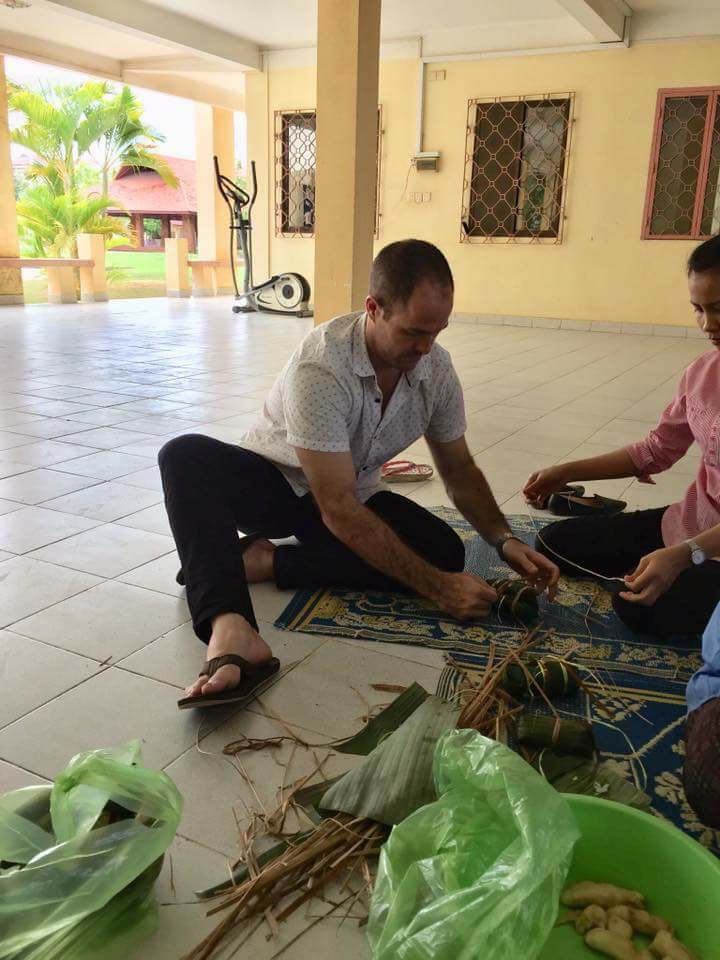
Being taught how to tie a Khmer dish of sticky rice and banana.

In the lead up to teaching at the Bible school there were days where I felt nervous about teaching in Khmer. Naturally. Partly this was because I was attempting to teach in Khmer after less than two years of language learning. And while I knew it would be really helpful for my Khmer it was also going to be painful as well.

One of the bits of advice that helped calm some of my nerves and continue on with teaching prep was this: “You’re not teaching Khmer, you’re teaching THE BIBLE in Khmer.” This advice was, in some ways, freeing for me. I didn’t need perfect pronunciation. The goal was for my students to grow in understanding the Bible. That could happen even if my pronunciation or use of Khmer phrases left a lot lacking. I needed to remember I’m teaching OT, not Khmer. Khmer, in this sense, is the instrument, not the goal. So even if I only had a few notes to play in Khmer, it was helpful to remember that a skilled musician only needs a few notes to play beautiful music.

In my repertoire was a decent ability to teach theology with a significant weakness in my Khmer. Having clarity on my abilities was helpful as I moved forward in my preparation. The way I visualised this, particularly on the days when I felt more nervous, was that I saw my teaching experience as a prop while my Khmer was in its infancy stages. I could rely on my ability to teach while I waited for my Khmer to improve. Two benefits that came from this thought process. The first is that it calmed some of my nerves when my mind would begin to run away with fears and anxieties. But secondly, and more on this in the next post, it helped shaped how I prepared for teaching and the content that I would use in teaching, including teaching methods.

Overall thoughts on learning language FOR US.

As we come to the end of our first term, here are some more big picture reflections on language learning in Cambodia for us. I say for us, because this is different for everyone.

A big part of learning a language is having goals (like I want to be fluent or I want to do this with a language). These goals help shape what you’re learning. And we were prepared for this in our mission training. What I wasn’t as ready for was how much a persons context plays into their language learning. While most people have goals in language learning, I’ve been seeing how context plays a big part in how we pick up a language. Three contexts that influence our language learning are the country we reside in, the ministry we are a part of (or hope to be) and our personality that we bring to learning a new language.

Pre-arriving in Cambodia, I was hoping for fluency in the long run and in the medium term the ability to teach in Khmer. I was also hoping that my kids would be fluent too. Now I see how much context plays into our language learning and affects our goals. The short answer is that I’m much more flexible on language goals seeing how much contexts affects us.

It’s been interesting to see how the country that we are serving in plays into our ability to learn language. Below are some observations that I’ve made on how Cambodia, our ministry and my personality context affects our language learning.

Country context:

  • Khmer is an Asian language, so there seems to be a longer acquisition time in comparison with learning a European language. This is important to keep in mind for myself so that I don’t make unhelpful comparisons about rates of language acquisition with missionary friends in other countries.
  • Cambodia seems to have more of a culture of foreigners who don’t learn the local language. Now there good reasons for not learning Khmer and not so good reasons as well (of which I won’t go into). One of those reasons is that you can manage to live in Cambodia with English and only a little Khmer. I’d also like to say I’m no expert, so it may be that other countries have just as many missionaries or expats who don’t know the local language. The main affect of this seems to be that locals are always expecting me to speak in English when we first come into contact.

Ministry context:

  • While my educated guess is that while living in the province it is easier to learn language, we have chosen to learn Khmer in the city (see point below). I think my speaking and listening would have been better if I had learnt Khmer in the province, but I wonder if I could have been reading and writing as well as I can now if I had learned those skills in the country.
  • Our goal has been for me to teach the Bible in Khmer. In order to teach well, while having good Khmer is sought after, what’s more important is that the students understand the Bible better than before the class.
  • Part of our ministry context is also family context. Our kids don’t have the exposure to the Khmer language in the same way that we had expected before we came. This changes our family’s ability to function in different Khmer settings (weddings, holidays, outings and other things). More on this below.

Personality context:

  • I have high expectations. While helpful in some ways, I also need to be aware of pushing too hard. The outcome is that any time I have a chance to lower my workload, this is probably the right move for us given the context of just settling into a new country in this first term.

These are just some of the ways our context has affected our language learning. So where are our goals currently as we finish one term and prepare for another?

Currently: We want our kids to love Cambodia whether or not they learn the language. This is more important to us. They can function in Cambodia without a lot of Khmer, so if they come away from our time here loving Cambodia and the people, but not knowing a whole lot of Khmer, that’s a win for us. In terms of Sam’s language, we want to be mindful of the gap between Sam’s Khmer and mine. However, what’s more important is not so much the gap between us, but that Sam’s language continues to improve at the pace she is able to go at.

Being on location has shown us how, while language goals are important, context also plays an important part in learning language.

End of 1st term language update

The kids bible (aimed at roughly 10yr olds) is easier reading for me whereas reading a simple Khmer version of the Bible (the Message standard) takes more effort.

So where am I up to in learning Khmer as I edge towards the end of our first 3 year term here in Cambodia?

From my point of view, I feel like I speak like a 6 year old with a slightly larger vocabulary (although, my vocab is heavily weighted towards theological words). I have just finished the academic year teaching at Phnom Penh Bible School in Khmer. Teaching Old Testament subjects this last year has greatly assisted my language skills, not only with vocabulary, but with lots of practice in speaking and listening. I feel like my reading is still ahead of my speaking. I feel like I’m able to read literature that an average 9 year old could read.

What my current language abilities means for straight forward conversations is that I go in fairly confident of decent success. Success for me in language at the moment is not so much about getting perfect pronunciation or understanding every detail (although, this is good if I can). Success for me is about outcome. Is there successful communication? If I have understood what is being communicated or they have understood what I am communicating that is more important than the specific language skills like pronunciation. Communication is how I measure language success at the moment.

A focus on language outcome (communication) over language skills is like team sports for me. You can have an all star team and still bomb out, because no one can work together. Conversely, you can have a team full of average players that absolutely kills it because they all work together well. This is what I’m going for. While I’d love to have a few all stars in my language abilities, I’m much more concerned about how everything is working together and the result. If I come out with a win (comprehension or communication) that’s what matters to me.

So I’m certainly more able at Khmer than I was 2 1/2 years ago. However, my expectations have also grown. Although I can do some things in Khmer, I still desire to go deeper. I still get to conversations and places in conversations where I want the ability to say more or understand more but can’t because I don’t have the vocab or ability to use that vocab or the cultural understanding that comes with years of living in a place. So my expectations for myself have moved on from where they used to be and as always they are ahead of my actual abilities.

BUT I am trying to take the big picture stance, which is that I’m very content with where my Khmer is up to for my first term; I’m thankful for where I am as I look forward to more growth and improvement in the years to come.

Language learning update

20181112_1602023203519399143278135.jpg

Visited my old language school stomping ground, G2K.

Thought it was about time for a language update given its been nearly 8 months since my last update. I have now given 2 lectures on Old Testament at Phnom Penh Bible School, in Khmer. My Khmer reading and writing have improved dramatically having now prepared 4 lectures. When working from my English draft I can translate it to Khmer in about 6hrs (that’s about 6-8 pages of written Khmer). My speaking (more of a lecture form of speaking) is improving slowly with each new week of teaching. My speaking in conversations and with questions is still where I find it the hardest. There are many conversations where I can get the main point and answer well. But below are three scenarios that still happen with regular frequency. I’ll be listening to a conversation and the speaker will be talking and I’ll hear:

I’m worried… don’t dare… addicted… [unspecified time] so I don’t want coffee 3 cups… [unspecified time] 3 pigs not in there but there is either pork or chicken… the fish blah blah blah which means blah blah blah and then… it’s cooked.

In some conversations, this is what I get out of the Khmer that I hear. Most of the time I understand a good majority of the words. But because my grammar understanding is still growing and my processing time is also slow, the conversation is onto the next sentence before I’ve processed and understood the last. What this means is that I use the words and other clues and try and guess the meaning and can usually get close. This is at my best.

Then, there will be times like this:

Question: Khmer Khmer Khmer Khmer Khmer Khmer Khmer?

Me: Could you please repeat that?

I didn’t catch any of what was being said, but I have enough energy, time or motivation to try and find out what was said.

Then there are times like this:

Person speaking: Khmer Khmer Khmer Khmer Khmer Khmer Khmer (either a question or statement, I’m not sure)

Me: Yes Yes Okay Yes

Me (to myself): I have no idea. What did I just agree to?

Unfortunately, there are also these days. Where I have no idea what is being said, but I just nod yes either because I don’t have the time or energy to figure it out — the bobbing dog head syndrome.

This next year at the Bible School will provide opportunities for exponential gains in my language abilities. Stay tuned!

No-longer New: #10. My independent language learning

IMG-20180507-WA0000

It’s all Khmer to me???

One of the things I love about independent language learning is that on ‘home days’ (learning at home rather than in the classroom) I get to wear what I want, what’s comfortable. At school, I wore more culturally appropriate clothing; long sleeves and long pants. This stage of learning reminds me of when I was studying for my Masters in Theology in Australia, though that time was winter and I was wearing my jumper and uggies (read sweater and ugg boots). Still wearing comfortable, but in a different way.

My last post hopefully gave you a general sense of the changes in my language learning. This posts delves into some of that detail of my independent language learning to give you a better sense of the changes.

Planning:

So what will this next phase look like? Well, it won’t be full time classroom (3hrs a day, 5 days a week). Instead, the first step is to set up some goals. These goals will then help direct how I set up my time. The more concrete these goals are the better. This is because the more specific these goals are, the easier it will be to plan steps needed to reach the goal. This in turn will mean that each step has clarity, helping me to execute each step and get feedback on how I’m tracking. On an aside, in chatting with a mentor of mine back in Australia, success in this sort of plan will include the plan’s flexibility. Because I’m diving into new waters, a good plan won’t be one where I know if the goal is achievable from the outset. A good plan at the moment is one that adapts to new situations, even if those changes occur weekly.

Aiming at different skills:

The way I’ll work out the goals is basing them on developing and strengthening skills that I’ll need in order to be able to teach in Khmer. So these goals will cover all modalities: listening, reading, writing and speaking. In terms of speaking there are two basic types of speaking (and tied very closely to that, listening) that I want to work on: presentational and conversational. In one you have more control, the other being more dynamic, and so each requiring different skills. So on the first I’ll need to work on clarity and precision and on the latter adaptability and reactivity. In terms of reading and writing, I’ll be aiming at building my vocabulary surrounding biblical terminology and themes. While I’m aiming for my reading to enhance my vocab and so also my speaking and listening ability, I’m conscious that I need to work on Khmer conversations in order to not end up sounding just like a book. In order to execute this plan I aim to be around the Bible school (in an informal way) more over the coming months in order to use this context as the location of building these skills and reaching my language goals.

Targeted and random language learning:

Flowing out of the independent language learning seminar was a strong emphasis on what I’ll call targeted language learning. The key in this sort of learning is what’s called comprehensible input. That is, you aim to learn one or two new things from a piece of text or conversation where you already know a significant amount of the material. That way you’re not being flooded with all this new stuff that you are unable to use. Instead, you aim to learn one or two new things. Then take those one or two new things and use them in other ways, to build understanding through using them, to remember them and make them more familiar. What this requires is a good amount of preparation. Tutoring sessions, in this manner, will require a good amount of preparation. Which means that if I want to do 3-5 hours of tutoring a week, I’m easily spending that amount of time in preparation or follow up. What this means is that if I was doing 15 hours at language school, I can’t expect to do the same amount given that I’ve got the prep to do as well. The exciting thing is that I get to direct how this goes. I’m looking forward to some more self-direction. I valued it when I did my masters and so I’m looking forward to it now in this different context.

The other sort of language learning is what I’ll call random. In this model, I’m aiming not only to practice and become more fluent in what I know. But I’m also aiming to glean new things as I come across them in different situations, where I haven’t prepared. I see this occurring around lunches, during sport, in casual conversations. I’ll learn just by being there, rather than by being prepared. So as well as planning and setting goals, part of my language learning time will be planning just to be there, immersing in a different way.


No-longer New: #8. Language update

IMG_7694.JPG

This is a shot from the role play I wrote as part of a in-class presentation that I gave in Khmer.

Where am I up to after a year and a bit of language, after 40 weeks of full time language school? The short answer is: I’ve come a long way, but I’ve got an even longer way to go. A more specific question is what’s changed in this last 6 months on from my last update?

Conversations:

Arriving in Cambodia early last year, I had almost no Khmer. Now I’m attempting conversations in Khmer and these conversations are moving beyond the basic fact finding questions of personal data (age, family, work etc). Though I still need to learn much more vocab, I’m finding now that I’m using strategies to keep conversations going, even without having the vocab. This is one major difference between my conversational abilities now and even 5 months ago. 5 months ago, once I asked a quick question and got a quick answer, it was hard to move beyond that point. Sometimes we were just left awkwardly standing there, like one of those scenes everyone fears at a party when the conversation dies. Now with a bit more language what I’m finding is that I have more topics to turn to in general chit chat. A break through in shooting-the-breeze came recently. I’d been struggling to work out what to talk about when I meet up with a friend, beyond the personal data that I’d found out first time I meet with someone. It came as an off hand remark in a seminar, but I’ve found it really helpful. Easy go-to topics in Cambodia are “where have you been?” Or “where are you going?” Through to “have you eaten?” Or “how are family members (either where are they or how are they doing)?” This has given me a couple of topics that I can use as I seek to build my conversational skills.

Content:

The result of my language learning so far is that in general day to day life I can function doing simple tasks and having simple conversations in Khmer, conveying some information and understanding some things as well. What this means is that I’m understanding more content on a regular basis. In a recent update, I shared that more often than not I got a sense of the topic that Khmers were talking to me about. Now I don’t just get a sense of the general topic, but I get a sense of the general point they are making about that topic. I’m understanding more conversational content. I still miss many of the details, but I get the general topic and the general point about that topic.

This doesn’t always occur across the board in every conversation and it can often vary based on how quickly Khmer is being spoken (often in conversation it seems to go at machine gun rate) as well as other factors (like background noise and the topic of conversation). But more often than not I’m understanding a decent amount of content. Some of this improvement in understanding more content has come through practice (having similar conversations), some through increased vocab (in my vocab app I have about 2000 words) and some has come through an ability to use questions and responses to check I’ve understood or hear that they’ve understood me.

Confidence:

6 months ago I was hoping to improve my conversation abilities and fluency. And looking back even in the last 6 months I’ve seen that happen. The result is that I’m trying to put myself in more and more situations where I need to use my Khmer and I’ve got more confidence — not confidence to get it right, but confidence just to give it a go and learn something. That’s how I would summarise my conversation ability: confidence to have a go. The result is that I get to practice what I do know and in each conversation I have the chance to learn something new to add to my language arsenal.

One story before I move to reading and writing. Sam and I recently looked at one of my first videos where I tried a bit of Khmer (it was in the first month of arriving here). One of the ways I can see improvement in my Khmer is that as I listen to it again, I cringe. While I gave it a good crack for only being here 1 month, I can now see how my pronunciation was wrong and I can see how I’ve improved in this last year. I’m sure there will be more of that happening as I continue to look back.

In terms of reading and writing, I’m feeling much more comfortable writing and even writing small paragraphs of text. My vocab and reading ability will help improve my writing beyond this, but I’m happy with where my writing is up to. As I finished up with my language school, we were encouraged to keep up our writing if we wanted to keep it. Like a lot of skills, if you don’t use it you lose it. So this is my goal. But more about that in the next post. In terms of reading, while I’m progressing, one of the main difficulties is that my vocab is holding me back. As I add more words to the mix, I think this will help free up my reading. And in this next stage, as you’ll see in the next post, there will be more opportunities for reading.

Mid-year musing #9: Language update

Below is another visual representation of where my language is up to since the last update .

First he blah blah for breakfast, then after blah blah blah he arrived at work. He told blah blah blah blah. Good work not enough but still need to have help with selling. At the market he bought fruit and veges he thought blah blah blah and so he could only get 1 mango as they were expensive and he wanted an ice cream. He didn’t like the veges and so he went and played soccer with his friends blah blah blah blah blah (by this stage I’m lost and so I get less and less) blah blah home blah blah blah family, brothers and sisters, friends blah dinner, sleep blah blah blah.

So where is my language learning up to now? Earlier this year I passed an exam which identified me at the level of being able to get the main topic of a conversation. I now feel I have more ability in getting the main idea, whereas before I was more just hearing connecting phrases (and, so, then, but etc). However, I’m still left guessing from context and other cues about what is actually being said about that topic. This is a start. The task now is to grow in my listening ability which includes using other listening tactics more, like listening for emotion and body language, to guess what is being said about a topic. You could sum up my listening abilities currently as an educated guess. Picture me having a 3 year old’s vocabulary and listening ability and you’ll have me pinned.

What this means for conversation is that I have the foundations set. I feel much more confident with fairly mundane questions and answers about myself and others (family info, where I live in Phnom Penh and how long I’ve been here). What’s next is taking those educated guesses and exposing myself to lots of conversations. Only, the trick is not to go for perfect understanding, but more … going for the gist, the vibe, the mabo.

The danger at this stage is that I’ll want to work out each little bit that I don’t understand. While clarity is a good thing to have, stopping at each point that I don’t understand will slow conversations down to the point of non-existence. That is, if I get so fixated on one detail I’ll actually miss the chance of experiencing conversations. One fellow language learner, who is a few modules ahead, affirmed this ‘guessing’ over ‘stopping’ approach. What I miss in trying to understand every new word is the bigger picture–the forest gets lost for the trees. So I need a bit more ambiguity tolerance required here as I listen.

Last time felt that my listening was far worse than my speaking. That may be the case. What I think is far more likely is that I probably had an over-inflated sense of my speaking ability. What I feel like now is that I’m starting to get to the point where I understand more when I listen, but now don’t have the words or ability to express similarly to what I am hearing. So that’s where my listening and speaking is up to.

But wait… there’s more now… I’m not just listening and speaking.

I’ve also started to learn the alphabet and some basic reading rules. The trickiness is that learning new reading rules for a new alphabet is like a double whammy. It’s not like I’m just learning a new maths equation that I can apply to a number system (1,2,3…etc) that I know so well. It’s like trying to learn a new rule for a completely different number system that is still quite new to me–so which order do ថ​តេរតសដថងសង​ go in? My brain is doubly strained. First I’m trying to remember the new rule and then trying to apply it to a system that is not familiar either. Weak consonants follow strong consonants, but which ones are the weak ones again and which are the strong?

On a more positive language note, I’ve been noticing that as I use more Khmer phrases at home, my kids are picking some of these up. They can ask for things in Khmer and describe their preferences. But far above anything else, my kids all love to say ‘no’ to me in Khmer. Another positive is that my pronunciation seems to be improving. A friend of mine commented on my clear pronunciation (a product of our school). On the family side, my kids are no longer pulling me up on saying the number ‘one’ incorrectly–within two weeks of us arriving in Cambodia they knew that I was mispronouncing ‘one’. So either I’ve improved in my pronunciation or they’ve given up correcting me. Both are possibilities.

What I’m looking forward to about the next few modules is working at increasing my fluency in both reading and conversations. Part of this will come through practice–in a sense doing what I can do now, but slightly better and slightly faster. It feels like these first four modules have given me the basics and now its time to build on them.

Another thing that has happened in my current module at language school is that the teachers have phased out the IPA (International Phonetic Alphabet). Not completely, as I’m sure I’ll still use it in some way. But now we are being taught new words in Khmer script, rather than using the IPA. This means I rely heavily on remembering the Khmer script.

Finally, my Khmer will improve as I build my Khmer word vocabulary. I currently have about 1000 words in my vocab that are usable. I’m back at the daily ANKI1 slog (which I love). I remember someone saying, somewhere, that to read a newspaper in a foreign language you need about 2000-3000 words. This is what I’m aiming for by the end of the year or by the beginning of next year.

So that’s roughly where I’m up to. The result of all this is that I’m really enjoying the interactions I’m able to have with locals as I build relationships and seek to point them towards Christ in not only my actions, but also in my Khmer.


  1. A language learning app that I thoroughly recommend.