Settling in: #8. Language ability update

Below is a visual representation of what I heard when someone is speaking to me in Khmer about a month ago:

Blah blah blah blah blah BUT… blah blah blah blah blah blah blah blah ME… blah blah blah blah SO… blah blah blah blah blah YEAR… blah blah blah blah blah blah blah blah blah DAY… blah blah blah blah blah blah blah blah blah blah THANK YOU.

Have you figured out what the above paragraph is about??? Me either.

A month later (now) it’s more like this:

Blah FATHER blah blah blah BUT… blah DEAD blah EXCITED blah blah MONEY blah ME… blah JESUS blah blah SO… blah SAD blah blah blah YEAR… blah blah blah blah blah GOD blah blah blah DAY… blah blah LOVE blah blah (I THINK HE SAID TEACH) blah blah blah blah blah THANK YOU.

So its been about four months of full time language learning. Where are we up to? Well, in one sense, “not far” is the short and obvious answer. But in another sense, we’re exactly where we should be in learning the language. I’ve just started learning the Khmer alphabet a few weeks ago. Our language learning centre has emphasised listening and speaking first, to enter into the language and culture more verbally through conversation–speaking and listening. This approach is in contrast to a method that begins more through books–reading and writing. Neither is necessarily more right. Both have their strengths and weaknesses.1 One strength of this method is that we are both often complimented on our pronunciation.

Our language classes have been working at growing our capacity to speak and to listen. So what does that look like? With speaking, we’ve gone from no ability to being able to ask simple questions in order to get to know people. And recently we’ve been able to ask simple requests from our house helper and tuttuk driver, or even say thank you for particular jobs that our house helper is doing.

This has made a huge difference. For one, the other day I understood when our house helper asked to come in early and finish early because she wanted to go somewhere. I worked out the next day that it was to a family wedding. So there are improvements in our langauge, of which I couldn’t have done that even a month ago. With our tuktuk driver, we can organize pickup and drop off times in person and on the phone, as well as interact in little conversations about how we are going.

An example of our listening ability is to a sermon in church. I’ve gone from no word recognition to understanding about 1 in every 20-30 words and probably more now. Unfortunately, they are mostly just connecting words like ‘but’ or ‘I’ or other simple words that don’t really give the sense of what is being said (like the above visual representation). But even this is a cool win. There are many times when our house helper or someone similar mistakes how much language we have and go off into a very long winded and fast description… and I’m left just nodding saying ‘Yes’ (‘baht’ for boys, ‘ja’ for girls) though I have no idea what she said. Hopefully, it’s nothing too important…

At our language school we’re at the level of ‘survival Khmer’ or just above–enough Khmer to get around Cambodia doing basic tasks. By early next year I am hoping to be able to have moderately deep conversations, delving further into relationships. As far as writing and reading, my best guess is that our language centre emphasised speaking and listening first so that we could be growing that skill while we do the long and arduous task of learning the alphabet and putting those letters into words. So while reading and writing will come later this year, that hasn’t stalled us communicating and building our vocabulary from verbal means.

One encouragement we have had in learning Khmer is that many of our Cambodian friends are surprised with how well we are doing learning Khmer. The context in Cambodia is that many foreigners pick up only a little Khmer or none at all (even after many years of living here). Our efforts in learning Khmer are often appreciated by those we meet.


  1. I think one of the advantages going into a language orally is that you are more dependent on people in your host country guiding you. I feel like this is a more ‘bodily’ entrance into a culture as opposed to a more intellectual approach that you might get through books. With books you are more the guide. But with people it is much more obvious who the guide is. Hopefully the end result is that we not only can speak Khmer, but we develop similar mannerisms and habits to really inhabit Khmer culture. But who knows? 

Settling in: #7. Language learning is like tennis

20170419_154109

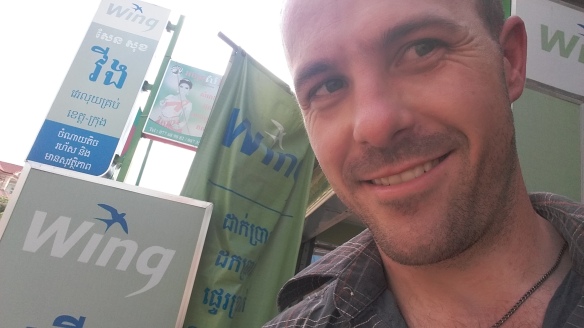
Wing: the place I pay my bills in Cambodia (unless I’m late and then I have to go an hour into town). BTW I now can read WING in Khmer.

Maybe God had a better plan than me when he put tennis in my background. Not maybe, definitely. I’ve found a few similarities between playing tennis and learning a new language in a new culture.

Firstly, learning in a new culture is like learning a complex skill in sport. You don’t pick up a tennis racquet and hit a serve straight away. You break down the skill into parts and work at each little bit. It feels a bit weird doing each part, but once you get good at the little bits you add a few of them together like building blocks until you work your way to the full serve. Learning a new language and learning how to function in a new society are similar. We learn to do more complex jobs based on learning simple jobs and adding them together. So now I can pay a bill–ON MY OWN–because of four smaller parts of this more complex skill. NOW I can ride a bike in a new country. NOW I know where to go to pay the bill. NOW I know how to use money in Cambodia (Go figure… 4000 Riel to each US Dollar). And NOW I’m familiar with the process for paying the bill at the shop (Wing). Put it all together and though it’s not the most complex job, I certainly couldn’t have managed it by myself in the first week.

The other way learning in a new culture is like tennis is those good and bad days for no apparent reason. In tennis you have those days where you can’t miss a ball. You hit all the lines. You’re in the sweet spot. The next day… You can’t hit a backhand. Your ball toss is all over the place. You just don’t have it. What’s changed? Often nothing. What’s the difference? Who knows? It’s just the ups and downs of playing sport.

It feels the same with language learning. Some days you come to class and your pronunciation is spot on. You remember all your vocab and you’re able to form questions with relative ease. The next day… You get pulled up for saying everything slightly wrong. Words are just lost in your brain somewhere… and don’t even get me started on trying to put a question together! What’s changed? Nothing! What’s the difference? Who knows?! It’s just the ups and downs of language learning.

The pay-off in all this skill building and up-down days is that one day you get to play a real a game of tennis–all the skills come together. The joy of all those hard days and training comes in a game well played. This is what we’re aiming for with language learning.

The bigger picture however, is that we’re not just language learning, we’re discovering a new world (Thanks MILL for that insight). That is, we’re not just doing language learning for itself, but as a means to enter into a new world. This bigger picture of participating in a new world helps put those down (and even up) days in perspective.

Settling in: #6. Ambiguity tolerance

20170406_080334

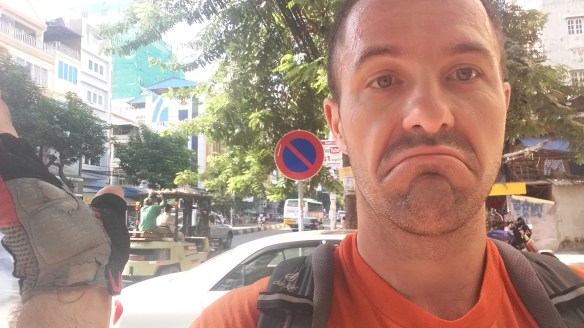
What does this sign mean? I have no idea, despite using the road everyday. This is me exercising some ambiguity tolerance. (BTW my confused face looks a lot like my undecided face)

I remember hearing the phrase “ambiguity tolerance” in training down in Melbourne. Then, on the first day of language class here in Cambodia, our teacher shared that good language learners are those who have ambiguity tolerance (or who work on having good ambiguity tolerance). That is, there’s much that we don’t know. But if we stop to try to understand every single detail before acting–or speaking, in the case of language learning–then we won’t get very far without being constantly frustrated.

I think what this looks like in a new culture is that we’re acting or speaking without knowing the full extent of what we are doing or saying. For example, in just using our favourite and usual tuktuk driver are we being loyal to him or showing an unhealthy favouritism in a collective culture? We’re just never really sure what our actions are saying or the effect they are having on others.

Now, this is actually how we ALL live, all the time, whether overseas or not. But this fact is highlighted more in a place where you know very little about the culture. Sometimes I do well at tolerating ambiguity. At these times, ambiguity tolerance enables me to relax, given I’m not going to have all the info I need before making decisions. At other times, the ambiguity is harder to deal with. Here’s one example:

My tuktuk driver said something to me and I had no idea what he said. He’d been driving us most places, most days for close to a month. We were seeing each other a lot; some days I would be in the tuktuk for 3 hours. I had started speaking in very poor beginner Khmer to him. He often said things to me that I didn’t understand, but I usually nod to be polite (a fairly usual pattern for us here in Cambodia). This particular day was a Friday and I didn’t think too much of it.

Anyway, the following Monday, one of his tuktuk driver friends showed up instead of him. I thought, ‘he must have just wanted a day off or had something to do’. A few days went by and the friend kept coming, not our usual tuktuk driver. I started to wonder whether he’d told me something important on that Friday. Was he displeased with us? Were we paying him enough? Was he going to come back? Did we have conflict I was unaware of? I wasn’t being tolerant to this ambiguity, and it was affecting my tolerance in other areas of life here.

I didn’t realise how much the ambiguity was affecting me until the 4th day when the tuktuk driver was late coming to pick us up. I started to hope. My regular tuktuk driver was often late, but his friend was always early. When I heard the tuktuk driver come down the street late, I was hoping it would be him (one of those times when you’re happy someone is late). And it was. My friend was back! I was so happy. I was happy because he was back. But I was also happy because the ambiguity of that situation was resolved. Unfortunately I couldn’t really tell him why I was happy.

This is just a small example of ambiguity tolerance. But this is one of the main ongoing lessons of living here so far. To survive in a new place, I’ll need to grow my ambiguity tolerance.

Settling in: #5. Growing familiarity

20170325_112819

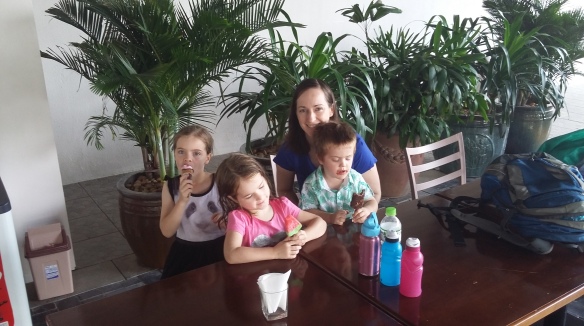
Our very ‘familiar’ family time is at a hotel that has a pool and cafe for treats.

Even in a short time it’s amazing how a foreign place can start to feel familiar. The school run, though only doing it for a few months, feels very familiar. Our route to language school also feels very familiar. The Khmer meals that our house helper cooks are less new and different and there are now some meals that we get very excited about when she is making them. And we’ve gotten used to living in our Cambodian house; each week it feels more and more like home.

This was brought home (hehe) to me a couple of weeks back. We managed to get out of Phnom Penh for the first time since we arrived in January. We couldn’t have done it without our good friends (locals) who helped us experience some more of Cambodia. But it was on the return trip that something struck me: We were returning ‘home’ to something familiar; familiar house and routine. We were coming home. There was a new sense in that word having left Phnom Penh for the first time and then return.

There’s still more to do and get used to in the house. There’s still much more to explore in Phnom Penh and much more to see in the countryside. Yet, its surprising how the different moves to familiar. With familiarity comes a joy and relaxedness. The stress hormones get a slight break and you’re able to function in a different way. In this sense, there’s not just joy in the new, but joy in the not-so-new as we settle into patterns and friendships that have enough history to make us feel like we’re not at square one. Things go from new to the new normal.

Settling in: #4. Don’t compare

20170405_122225

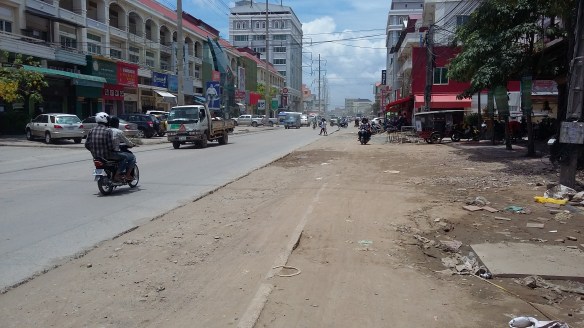
A major-ish road in Phnom Penh with a large shoulder. I love riding a mountain bike down that shoulder.

There are two dangerous comparisons that I musn’t make living overseas. The first is don’t compare the new country with the one back home. Instead, live each country as its own entity rather than wishing one was more like the other.  Thoughts like “I wish Cambodia was more like Australia” are not helpful. Comparison is a slippery slope towards resentment and burnout.

Of course it’s okay to compare. I just need to think about why I’m comparing and in what spirit I’m making the comparison–less grass is greener comparison and more healthy respect for both places. So comparing, when contented, is healthy and normal and even helpful. But if I’m tired or stressed or not going well in the new place, then I should not compare. At these times I just need to let each place be what it is.

For example, I could look at the above road and wish the roads were more like Australia, where the roads are paved right to the edges. That’s the sort of comparison I shouldn’t make. A more healthy comparison is to see that the upshot of these roads however, is that when they are packed with traffic, and I’m riding my mountain bike along the side, guess who slips straight past the traffic (even past all those tuktuks and motos)?

The second comparison that I shouldn’t make is with other missios or expats (people from other countries). The reality is that every single expat is from a different place and is here for a different reason and a different length of time. These multiple differences will affect all the choices they make and will mean those choices differ from mine with varying degrees. Comparison is helpful when you are aware that there is going to be a healthy and normal difference–where we are all just trying to make decisions in light of our own background, circumstances and purposes.

This comparison thingy is also particularly evident in language learning. I often need to tell myself “DON’T DO IT. DON’T COMPARE. GO AT YOUR OWN PACE.”

I suspect I’ll need to remind myself not to compare for many years to come.

Settling in: #3. Decisions galore

20170406_080900

A major intersection near where I study. Which way should I go? Decisions, decisions.

Yes, there’s choice paralysis in Australia too. But there is a new stress to making choices in a new country. As you settle-in in a new country you’re constantly having to make all these decisions about how you’ll live; not only where you’ll live, but how you’ll set up your house. Do you set it up to be friendly to local friends or as a sanctuary for the family? What should you do about transportation? A car may be cheaper and safer, but are they the only criteria?

For those who don’t mind what others think, these decisions don’t have as much weight. But for those who do consider what others will think, this is one of the harder things about moving to a new country. You’re never sure what impact the choices you make will have on others. You have more certainty in the country you’re from as you know the culture and how people think. But in a new country, you have mostly no idea how people are going to interpret what you do.

Added to this is that you not only have the local community to keep in mind, but you have a international community (expats) to keep in mind. Expats can be a source of help as you settle in. But here’s the catch. Each person/family has come from a different place, with different backgrounds and different experiences, with different purposes and length of stay in this new country. The range of choices people make are from one end of the spectrum to the other. This means that you’re having to sift through every bit of advice and try and interpret it for yourself.

In the beginning there are many decisions to be made. Eventually, the number of decisions to be made slows down. But you are very aware of each new decision that you make, and begin to deal with the unseen consequences of earlier choices. Again, in some way this isn’t much different from doing life in your own country. But settling-in in a new country means you’re making a lot of these choices all at once and you’re doing it with less cultural awareness. So, in short, a condensed period of decision making brings to the fore the act of making decisions.

Settling in: #2. The joy of early wins

20170405_183004

My first wet night ride. Notice my poncho goes into my helmet; thongs/flip flops as essential wet weather footwear (essential footwear in heat as well); and the trail of water behind my bike–the water was easily 20cm deep on our street. Not even wet season yet. Oh yeah, that’s two pieces of trash floating along right there.

Who’d have ever thought riding at night in the rain in ankle deep water was a kick? Such is the joy of settling into a new place. Simple things can give you such great joy.

Have you ever started a new sport or hobby before? One of the joys of starting that sport or hobby is that in the early days you see lots of improvement. You make what seems like big wins.

I was a regular bike rider in Australia – both for recreation and transport. I loved it. But riding in a new place is a joy, an early win in a different way. Riding, to explore and have some independence in a place where you rely on others for transport–win. Riding, after your first fall (with minor cuts and scrapes) in a new country–win. Riding in the wet at night, not just in sprinkles, but in water almost up to your pedals–WIN.

After you’ve been playing or hobbying for a while, those early wins diminish slightly. But in the early days, they’re more regular, more visible and more joyful.

The joy of settling into a new country includes getting good at living in that new country. Completing simple tasks provides easy wins, like learning how to buy food, learning how to get around (particularly without a car or obvious form of transport), learning how to pay bills, or setting up a bank account. All these things come with a sense of satisfaction that you might not have in a country where you are able to do more things. In the context of very obvious inabilities (settling into a new country), growing abilities provide a great source of joy. Bring on the early wins!

Settling in: #1. Newness tiredness

20170427_153051

We’re being very ‘Cambodian’ in combating our newness tiredness.

Overseas tiredness is different from tiredness in your own country. While being too busy is present in both, there is one major difference; as you settle into a new country everything is new.

In your own country there’s a mix of new and old. Often the old is easy to do–we do it without thinking about it. How many people driving in Sydney for 10 years get stressed by ‘the scariness of driving in Sydney.’1

In a new country, everything is new, nothing is old. Which means everything is hard work. Even the little things that you wouldn’t think about as hard, are tiring. One example is shopping. Where do you go to get food? You can’t get it all in one place. There is often one place for one thing and another place for the next thing. None of this is one stop shop; more like one thing per shop. It hurts your head just trying to figure these simple things out. So overseas tiredness could be better termed ‘newness tiredness’.2 Gradually things change. But in the beginning you’re hit with all the new.

We were told in training, ‘expect to sleep 2 hours extra each night overseas just to get by on the day to day.’ We’ve certainly experienced that. But Sam and I also employed two other strategies to combat newness tiredness (at least we did in the early days). Our first strategy was to just aim to do one thing per day. If you get more than that done, you’ve done well… but maybe too well (you’ll pay for it tomorrow). So really it’s ‘well done’ if only the one thing gets done.

Our other strategy is to think long term. We have the privilege of being here long term, which means we don’t have to try and cram everything in all at once. The result of this is that going slow is not only doable but will enable us to stay long term.

This newness tiredness doesn’t disappear overnight. Even after you’ve ‘settled in’ there’s still more ‘new’. In that sense, the newness tiredness hangs around indefinitely.


  1. There may be other reasons for why you are stressed while driving in Sydney. 
  2. Not only are you physically and intellectually tired, but you’re emotionally drained. Your senses are pumped full with new. Your values take a hit as you get used to a new culture and new way of living with different goals and values inherent in their way of doing. 

Catch up on Cambodia: Wrap up

rear-view-mirror

Looking back over this series, we’ve began with the origins of Cambodia, and moved through to more recent international influences. This paved the way for an snap shot of the Khmer Rouge, zooming in on the events and the effects of this regime.

In a sense … the taste buds kind … this series is really only a taster of Cambodia. I have much to learn about Cambodia and Cambodian ways of life. Hopefully getting a glimpse of Cambodia’s past and present will help you journey a long with us as we go and experience Cambodia – testing these early pictures. But also, hopefully this series will provide some context for the next series on mission principles. As we speak about how we will seek to share Jesus in Cambodia in specific ways, hopefully you’ll have a sense of the context that we will be serving in.

Catch up on Cambodia: Effects of Khmer Rouge

The effects of the Khmer Rouge still linger. As we get to know Cambodian culture, the effects of the Khmer Rouge provide an avenue into our learning about the culture.

  1. A nation suffering from PTSD. This, in a sense, seems to encapsulate where Cambodia is up to. The effects of the Khmer Rouge run deep and long. It has affected every aspect of society and will effect the culture for a long time; much like the effects of war seen in PTSD sufferers (Post-traumatic Stress Disorder). You see the suffering in differing ways. Some will be dealing with their past, by not dealing with it – running headlong into materialism to forget or deny the past. Some deal with it by bringing the past too much to the fore. One friend said people speak about it so much that it is unhelpful. While it is good to speak about our past, there are helpful and unhelpful ways of doing that.
  2. Double youth boom. Cambodia’s age demographic is completely opposite to Australia’s. Where we have an aging population, Cambodia is heavily weighted towards youth, with 50% of the population under 22. This is the result of the Khmer Rouge’s policy, not only of ridding the population of the educated (those often with age), but also of the unable to contribute to increased rice production (generally those who were elderly or disabled). On top of this was the pregnancy push during the war in order to expand the working population. The effect down the line, now is not only were the elderly wiped out in Cambodia creating an imbalance in the country towards youth, but those youth have now had families bringing on a second youth boom.
  3. A loss of education. Not that education is gone completely, but killing off all the educated, combined with the survivors having grown up during a period of war means that education in the country has been significantly affected.
  4. Gospel openness. From what I have read, one of the unintended consequences of the Khmer Rouge has been to create a culture of openness in Cambodia in relation to international influences. Their need for assistance following the war seems to have made the country open to the outside world, more so than their neighbours. Global interaction in Cambodia through many international organizations has created a air of relaxedness to the outside world that may help pave the way for the gospel to be preached freely and openly. Also, having witnessed the horrors of the Khmer Rouge, people may be more open to the good news of Jesus.
  5. Rapid development. Although more complex I suspect there is a link between the Khmer Rouge and the rapid development that the country, particularly the urban areas, are experiencing. The ashes of the Khmer Rouge have provided the space for an influx of money and development following and as a result of the war. And while much of the country remains in poverty, there is substantial development, particularly in Phnom Penh. People are saying that in leaving Phnom Penh and returning in 6mths time you won’t recognize the place because of all the change going on.


Here are five pictures of the current state of Cambodia following the Khmer Rouge as we think about sharing the good news of Jesus. Thoughts? Have you had a similar picture or different of Cambodia?