
Catch up on Cambodia: Very recent Hx

khmer4

Out with the new,

In with the old.

This was the Khmer Rouge’s strategy. They wanted to make the country prosperous again. Their strategy was to return the country to year zero, getting rid of modern accretions; going back to their roots. Anyone with education was classed as ‘new’ and received an immediate death sentence. Those kept were the ones who worked the land or didn’t have an education; the ‘old’. The plan was to massively up rice production to be exported and the method was through a commune strategy. Possessions, money, books were not only useless, but potentially harmful. Anyone with an education was targeted and killed. This was Cambodia’s ‘great leap forward’, done at break-neck speed.

The tactics of the Khmer Rouge were deception. The first was a false alarm call of bombing in Phnom Penh in 1975. From there deception flowed as children were pitted against parents to rat our anyone with an education. The Khmer Rouge soldiers were mostly young, yet their targets were any age and any religion; anyone that couldn’t contribute to their plan, young and old alike, both the religious and irreligious. In the few short years that the Khmer Rouge were in power, one quarter of the 8 million people in Cambodia died. khmer_rouge2_wide-3d773a7c402079fa5e8485ff03184bffba209cb3-s900-c85Half of those 2-3 million were killed, executed. The other half died from the effects of war, poverty, famine and disease.


The Vietnamese captured Phnom Penh from the Khmer Rouge in 1979. What followed was a 14 year struggle to work out how to bring political stability to a wounded country. Next post we explore some of the larger effects of the Khmer Rouge on the nation of Cambodia.
Catch up on Cambodia: More recent Hx

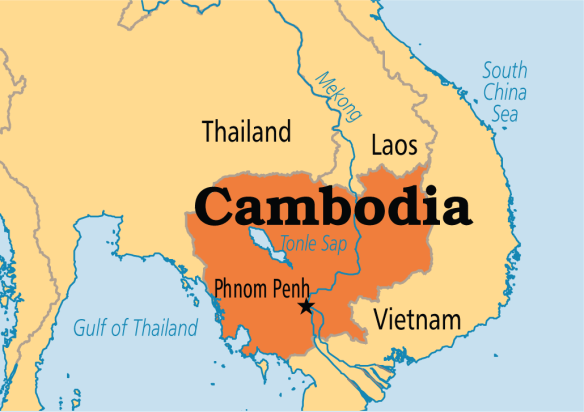
As we move closer to our time, Cambodia’s history is set in the context of its neighbours that we are more familiar with. Geographically, Cambodia can be found in the middle of your TV; Thailand on one side and Vietnam on the other. The relationship with both these countries is complex. There have been times of peace and cooperation between them and times of war. Both Thailand and Vietnam have sought to take advantage of Cambodia at different stages.

As you move further a field, more distant neighbours have also contributed to Cambodia’s history. China has had varying degrees of influence. This seems to be linked to Russia’s involvement in Cambodia. Of course there is also the colonial influence of France. The US, too, have played a part in the country’s history. All of these countries have had significant interactions with Cambodia, particularly in the modern era. We look forward to being in Cambodia and to delve into these influences as we get to know the culture.

Furthermore, most countries in the world have been affected by the Cold War period (communism vs capitalism or East vs West). Cambodia shares in this influence too. Prince Sihanouk’s rule of Cambodia in the 1950’s walked a fine line between capitalist and communist supporters in his own government. Communist parties formed in the country. Both sides of the Cold War would play their part in the events that led up to the Khmer Rouge.


camb-mmap-md

Catch up on Cambodia: Ancient Hx

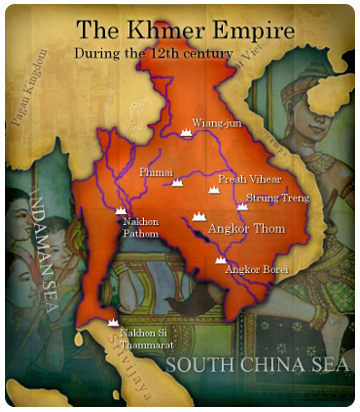
The heritage of Cambodia is traced back to the Khmer Empire. This Empire is often symbolized through its largest temple, Angkor Wat located near Siem Reap. This empire’s golden age was around the 14th century AD, with the empire spanning into parts of modern-day Thailand and Vietnam. Ruins uncovered around the Angkor Wat temple (pictured in our title) in Siem Reap have brought to the surface a vastly complex irrigation system that shows off a technical prowess of the Khmer Empire in architecture and infrastructure. Despite it’s hey day, the Khmer Empire saw decline occur not long after its golden age, around the 15th century AD. Some attribute this decline to a more ascetic Buddhist religion becoming prominent in the kingdom. Some attribute it to mismanagement of land that was sold off without much thought to the future. Some attribute it to a neglect of the irrigation system that led to this city and temple complex basically just being abandoned.

The Angkor origin of Cambodia reveals the country’s history and gives insight into the culture of modern-day Cambodia; a rich and beautiful culture. It’s own distinct Buddhist practices point to Cambodia’s unique character amongst its neighbours.

mapdjshkhmer512

Catch up on Cambodia series

The next series will be on Cambodia. We’ll explore a little of its past and present. The aim is to give you a brief picture of the country’s history. Hopefully it not only gives you a sense of the place, but hopefully will provide some context for our mission work. The series following this series will be on our mission practice. So having the Cambodian context will help us focus that discussion.

I’m no expert on Cambodia. In fact I’ve never been there before. What I’m writing may be off the mark. So if it is, help me get closer to the mark. I was given the opportunity to begin to get to know Cambodia more as part of our missionary training earlier this year. These blog posts come straight out of that time of study. I didn’t know much about Cambodia before this year. But as I’ve read and studied I’ve grown to love the Cambodian culture, even before getting there in person.

images