Jenny Asks #7

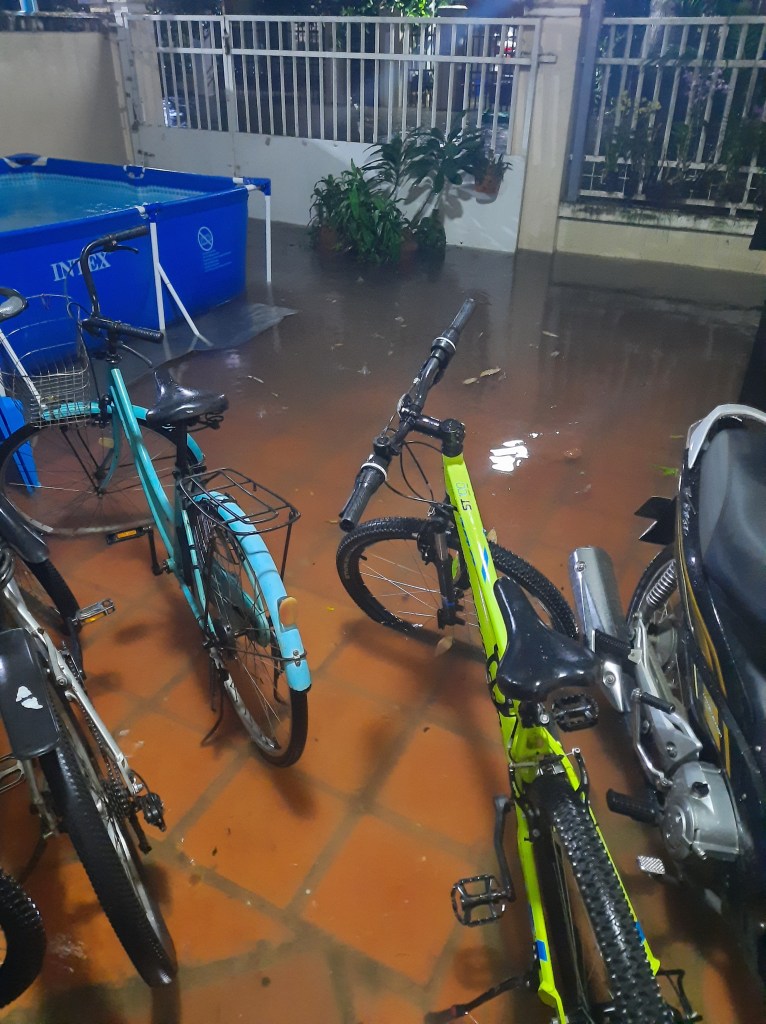
Notice the water colour difference between our pool and the flood? Yummy!

Previously on our Jenny Asks series we addressed our location in PP and shopping, then our neighbourhood and church, then traffic and walking, then getting to school and what we eat, then cultural miscommunication and friends, and what we do for fun and surviving the heat. On this final post we share about flooding and fixing.

Jenny: I’ve heard that your street floods quite a lot in the rainy season. Why is that?  

Sam: The first reason is that it rains a lot; frequently and with a large amount of rain in a short period of time. The second reason is that the drains are not well designed to move the water away and can also get blocked. The third reason is that our housing complex was built 10-15 years ago, so as more roads and buildings are built in the swamp land, dirt is added to make those areas higher, and the water flows to the lower area. This is also why the Phnom Penh Bible School floods, though it floods more frequently and for longer than our street. 

At the end of the rainy season this year we had the two deepest floods we have seen in our 7 years living in Cambodia. The deepest had water right up to the top step at our front door. When cars drove past, we had waves washing over the top step into our lounge room. 

Jenny: You’ve recently had some issues with a broken light in your kitchen ceiling. How do you think getting that fixed may have been different to getting the same task done in Australia?   

Sam: I was told by a missionary when we first arrived to be careful changing light globes as they can give off an electric shock. So, I have always arranged a handyman to come and change my light globes. Unfortunately, the new fluorescent globe in the kitchen didn’t work, as the light fitting was old and broken. Between the handyman and my house helper they decided to call in a third person to replace the fitting. Rather than replace the fitting, the electrician just put a globe onto the hanging electrical wire. When the electrician told my helper how much this would cost, she said it was too expensive. I heard him reply that, as a foreigner, I would be able to afford that price. Once the job was completed, I paid the money asked, and the 3 Cambodians remarked that, yes, this globe was lighter than before.  

In Australia I expect that changing a globe will not give me an electrical shock once turned off. I also suspect that light fittings would not break every time a globe needs to be replaced. And that if a fitting does need replacing, it will be replaced by the home owner/landlord. The cost would be determined by the task at hand, not by the colour of my skin. 

Hope you’ve enjoyed this series as we share about what its like to live in PP.

Jenny Asks #6

A family treat is a trip to the water park

Previously on our Jenny Asks series we addressed our location in PP and shopping, then our neighbourhood and church, then traffic and walking, then getting to school and what we eat, and cultural miscommunication and friends. This post what we do for fun and surviving the heat.

Jenny: What’s something you’d do as a fun family treat in PP?   

Sam: We have several movie cinemas nearby, and tickets are at most $6USD per person. This is fun when a good movie comes out, eg Marvel or Minions. Craig and Joel have been bowling. Craig also takes Clare to a rock climbing centre. We used to regularly go to a nearby hotel to swim, but this hotel has since closed down. We sometimes travel 40 minutes to a pool on Diamond Island to meet with friends on a Saturday. Another treat is going out for dinner, like pizza or Mexican. We also enjoy going to the water park, though this is usually if someone has sent extra money for a birthday treat.  

Jenny: It’s pretty hot here. What’s your favourite strategy for staying/getting cool?  

Sam: Drinking litres of water every day is essential! We have insulated drink bottles filled with ice and cold water every day. Running AC is also essential to staying cool on hot days, and nights when it only gets down to about 27 degrees. I let the kids have ice blocks, ice creams or soft drinks after school when they come home all hot and sweaty. The best thing to do is swim in a pool. Some of our neighbours have above ground pools in their yard. We can also go to a hotel nearby to swim there. From April – September we had an above ground pool in our yard to help us cope with the heat, it was lovely! 

Jenny Asks #5

Shirley came to see us off at the airport

Previously on our Jenny Asks series we addressed our location in PP and shopping, then our neighbourhood and church, then traffic and walking, then getting to school and what we eat. This post its on cultural miscommunication and friends.

Jenny: What’s an embarrassing cross cultural miscommunication you’ve had recently (mine was getting in the wrong tuk tuk but being convinced I was in the correct one)? 

Sam: I have cross-cultural miscommunication with my American friends on a weekly basis, ha! I haven’t had too many with Cambodians lately (that I’m aware of, ha). My two favourite mistakes were more to do with language. The first was 6 years ago when I told everyone for a week I was turning 45 (in Khmer this is “sae-sup bram”). I got SO MANY compliments on how young I look! Until my language helper said, in Khmer, oh I thought maybe you were only turning 37. To which I realised my mistake and corrected myself, that I was actually turning 35 (“sam-sup bram”). Whoops! 

The second mistake was when I was asking my helper how much she paid for something worth about $2.50 or 10,000 riel. Mid sentence I muddled the words for thousand (poan) and ten thousand (mern) and said “moan” which means chicken!!  

Jenny: Tell me about your friends. Where are they from? Why are they in Cambodia?  

Sam: We have friends from many places! A friend from Singapore who serves with OMF runs bible studies with many women, including a group of students from the university, and plans to equip Christians in a remote province. We have Danish friends who teach and equip vulnerable women at an NGO. We have several American friends connected to organizations that rescue and help reintegrate girls from sex slavery. A few people at church serve with SIL, or Wycliffe, with Bible translation work done for remote communities. We have other friends who serve at the Bible school, both Khmer and expat. We also know many people who teach at Hope, Logos or Asian Hope, the 3 Christian International schools near where we live. We know missionaries who use their religious freedom to share with people in Cambodia who would not get to hear about Jesus in their home country. The 2 families who live over the road from us have been in Cambodia for 20 years. Most people we meet come and go every 3 or so years. 

Jenny Asks #4

Saying goodbye to the car that served us well this second tour in PP.

Previously on our Jenny Asks series we addressed our location in PP and shopping, then our neighbourhood and church, then traffic and walking. This post we look at getting to school and what we eat.

Jenny: How do your kids get to school and back each day?  

Sam: I drive the kids to school in our car. It only takes 7 minutes, now that the school road is sealed – it used to be motor-cross bumpy and very ‘fun’ during wet season. School starts at 8am, so we leave at about 7:30 each morning. Pick up is at 2:30. Some days Craig will take one or 2 of the kids to school on the motorbike, eg he picks Clare up after soccer or basketball training on Tuesdays and Thursdays. 

In our last week in Cambodia we sold our Honda CRV and plan to buy another, bigger car when we return to Cambodia. Our growing children need a bigger back seat! We’re thankful to CMS and our supporters who enable us to take out a loan in order to buy a car on location. 

Jenny: What kind of food do you eat?  

Sam: In our first 3 years in Cambodia we mostly ate Khmer food in our home, made by our house helper. Her favourite dish to cook was ginger chicken, equal parts chicken and ginger. The past 3 years she has reduced her hours and stopped making meals for us. Khmer food has a high salt and sugar content, always includes meat and not many vegetables. At home now we mostly eat western food like cereal, toast, pizza and pasta, as well as meals like dahl and other vegetarian options too. We haven’t quite got the the American regularity of Taco Tuesdays, though we enjoy them. Cambodians are shocked when we report having rice once or twice a week; Cambodians eat rice three meals a day. Interesting fact, their ‘How are you?’ is literally ‘Have you eaten rice yet?’

Missionary as … Collaborator co-creator

The last description in this series is Collaborator or Co-creator. These two descriptions capture mission as a joint work together between missionary and locals, as equals, where both parties play a role. Although technically not a picture, the overall sense of both of these is in the combining of two parties in partnership towards one goal. And while I’m not technically a linguist, it seems to me that the term collaborator gives the sense of labouring together. 

A further aspect of these descriptions is the feature of both parties bringing expertise to the table in order to make something new. In this way, both parties are essential and neither is enough on their own. This resonates when I think about teaching theology; I’m trying to bring theological ideas through English to Khmer. My theological ideas are not enough on their own and neither is Khmer enough on its own. But in the combination, there is a synergy in the process of coming together. Co-creator builds on this coming-together aspect but also points to the creative aspects of partnerships, a creativity that mirrors the Creator. Something new is created as we wrestle with theology from English to Khmer.

Missionary as … Resource

I’m currently trying to write an article on missiology about the role of resources in mission. One of the things I’m toying with is the idea of a missionary as a resource. Money is clearly a resource, language too is a resource. Surely the missionary is a resource too. In this framework, I ask what the role of external resources is in relation to internal (local) resources. 

This picture of a missionary as a resource echoes the coach picture, here, in terms of being a resourcer. However, characterising the missionary as a resource provides some passivity to the missionary role. That is, the resource is at the service of the local. They can use the resource in the way they think. Instead of it just being about what the missionary thinks is important, they allow themselves to be directed and used like a resource would be. They hand over power to someone else. This picture seems to empower the local while at the same time disempowering the missionary in a vulnerable way. Agency is located more with the local than the missionary. 

Even though missionaries may know a thing or two, their expertise in this metaphor are placed subordinately to the locals and directed towards goals that the missionaries themselves may not have thought of or thought important prior to being involved in mission. As a resource the missionary is put in the service of another rather than servicing their own goals.

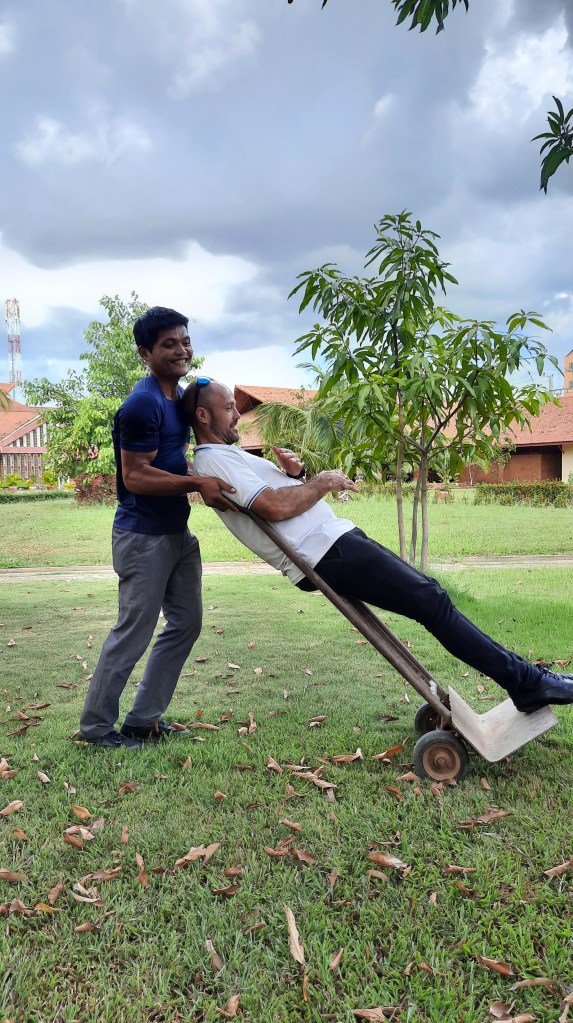
I like the picture, because my arms display my unreadiness. When you are the resource, change comes not from a position of control, but from outside and we are less ready for it than when as the agent we try to make the change happen ourselves.

Missionary as … Goalie

This description, shared before, here, combines the sniper and coach in a different way. The goalie has special skills that the other players don’t. The missionary as goalie emphasizes that mission is done together as a body, as a team, not just as an advisor. They have an important role but they are generally not the ones kicking goals for the team. Their place is at the back, sort of behind the scenes in some sense. Yet being at the back they see things slightly differently from other players who are more in the midst. Good goalies will communicate what they see to the whole team. They provide helpful information, like a coach, yet as a player. Goalies have some special abilities that other players don’t. They can use their hands. However, their special abilities are limited to a small arena in comparison to the whole field. The goal square sets good limits on the goalie’s abilities to be contained and used for the right purposes.

When I think about theology in relation to mission the role of the goalie resonates in this regard. Missionaries can provide a wealth of information particularly in relation to theology that comes from the world-wide church. Like the goalie they provide a point of view that assists the other players as they create and apply theology. Yet they are not the ones who see theology develop (score goals). That is done by other players, by the teamwork of the whole team, goalie included but not goalie exclusively. In preventing goals, maybe this is a good metaphor for preventing heresies or problems from occurring. Yet in reality this is a normal part of missionary work. We help and yet even in our helping we create problems, hopefully unintentionally.

The goal square for me feels like Phnom Penh Bible School (PPBS). In that square I can jump around and use my hands. Outside PPBS, I’m not only limited to my feet, but the goal remains unguarded. Thus expeditions out of the square should be well calculated and brief as I focus on my main role.

Missionary as … Coach

My height advantage didn’t help at all

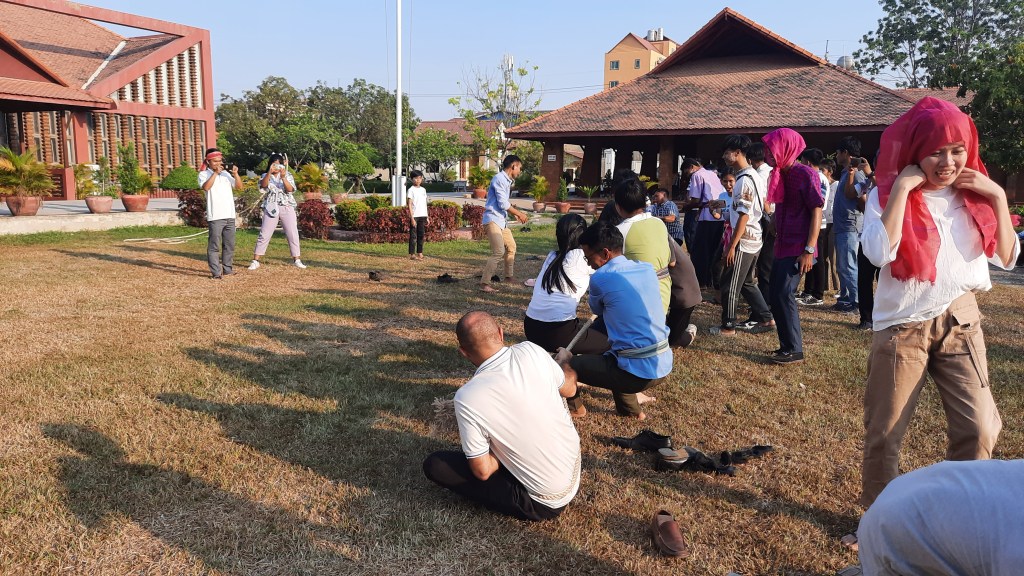
Although as a player in the picture above, my size makes me stick out in a similar way to the coach who is wearing different clothes to the team.

I wrote about a missionary being like a coach previously, here. I like the coach picture because it shows that a missionary plays a different role to locals in the game of mission. They are a support role, they are not the players. They are advisory only. They can help before in preparation. They can help after in debrief and recovery. During the game they can only assist, they cannot control or take over (generally speaking and with slightly differing degrees depending on the sport). Instead of the focus being on the coach, the action is focussed on the players and their resources rather than what the coach can do. Whether the coach sits in the box or on the sideline, they stand outside the play. Even though they stand closer than the crowd, they are not as close as the players.

If the bridge metaphor shows how a missionary connects to cultures in their person, and the sniper metaphor shows the timeline of a missionary career as well as their target, the coach metaphor explores the outsided-ness that a coach has despite being close to the game; there is both proximity and distance. Next week I start to mix metaphors as I explore the missionary as a player, the goalie.

Jenny Asks #3

A moto has become vital for Craig in Cambodia

This is the third installment in a series that we hope helps convey some of the basics of life in Cambodia. If you missed the first and second one, they are here and here.

Jenny: The traffic in PP is pretty crazy. How do you get around?  

Sam: Yes, it is crazy. In our first 3 years here I only used tuktuks, and Craig rode a bicycle. In 2021 I felt ready to drive here, so CMS helped us to buy a car, a 20 year old Honda CRV. Learning to drive on the other side of the road, on the other side of the car, was a challenge. I have put on the wipers instead of the indicator more times than I can count! That’s nothing compared to the challenge of the complicated road situation. There are so many motorbikes, trucks, tuktuks and other random vehicles all moving around each other. The give way “rules” seem to be the opposite of those in Australia. I am not ready to drive on the highways, though Craig has. Overtaking here is frightening, and there are bicycles, motorbikes and tuktuks all travelling on the sides of the road, in both directions. I had my first accident in my first week of driving when a motorbike, with driver and passenger, crashed into my driver’s side door. I had my second accident a few weeks later when a motorbike ran into Hannah’s passenger side door. Thankfully no one was hurt. This year CMS helped Craig to buy a new motorbike. He rides everywhere now and it’s very convenient for him. For more thoughts on driving in Cambodia, see here.

Jenny: It’s quite hard to walk to places in PP. Why do you think that is?

Sam: The “footpaths” here are designed as a driveway for motorbikes to access shop fronts in each house or building, rather than as a place for pedestrians to walk around. Most people have a moto, so they get around on the roads, even if they are travelling a short distance. Having said that, any time that I need to walk on the roads to get somewhere, or cross the street, I feel much safer doing so here because the traffic is much slower, and Cambodian drivers seem more aware of their surrounding and to expect the unexpected. The heat and humidity also is a huge negative factor in not walking anywhere. Who wants to arrive somewhere in a ball of sweat?

Missionary as … Sniper

The picture of a sniper resonates with my experience of being a missionary particularly as it relates to timeline and target. On numerous recountings, I have described a former missionary’s perspective on mission to me, as we chatted at CMS Summer School one year. He said to me in the first term, learn the language and don’t kill anyone (other versions are stay married or make a friend). Second term, you can make a list of all that needs addressing. Third term, you can address the first item on that list only. Over roughly 10 years, this is a rough sketch of the missionary timeline and target.

To me the above timeline and target matches the picture of a sniper as one part of the way an army wins a war. Snipers have a key expertise. They can take out a small target from a long way away. In terms of mission service, aiming for taking out a target in the third term of service echoes this ability. It echoes the waiting and watching, basically just the time involved in this task; mission work is time intensive. Patience is required; is demanded.

The sniper pic also echoes needing a good vantage point; it takes time to learn a new culture and be able to start to speak into it. Even though I know Khmer culture more now than when I first came, I’m less inclined to offer strong pronouncements about what Khmer Christians should do; my vantage point has shown me all the things that I don’t know about Khmer culture. A wise missionary said it was easiest to teach a book of the Bible, harder to teach doctrine and even harder to teach practical ministry subjects cross-culturally. Each step requires more and more cultural knowledge to do well.

Finally, the sniper metaphor highlights a sniper’s weakness. If the enemy gets in close they are at a disadvantage in hand to hand. While a sniper is specialised, their speciality is a liability when it comes to other activities. A weakness of mine at the moment is that I struggle to understand conversations between Khmer speakers that don’t involve me. This weakness reminds us that a sniper is only one part of an army. They won’t win the war, but they play an important part. Their specialist equipment speaks to the skills they bring that are ultra good at one thing and not great at others.

As I think about timeline and target in our context: First term learn Khmer (though, never finish learning). Second term begin teaching in Khmer and later give leadership a go. Third term becomes a culmination of the first two terms: improving teaching in Khmer as I lead in various capacities. This hopefully gives you a sense of my sniper technique in terms of target and timeline.